
Introduction
Search behavior has changed significantly, and zero-click search is becoming one of the most important developments for digital marketers in 2026. A zero-click search happens when a user finds the information they need directly on the search results page without clicking through to a website. This can happen through featured snippets, knowledge panels, local results, People Also Ask, and increasingly, AI-generated search experiences.
The scale of this shift is significant. According to 2026 research from SparkToro, based on Similarweb clickstream data, 68.01% of Google searches in the U.S. ended without a click during the first four months of 2026, compared with 60.45% in 2024. This doesn’t mean people have stopped searching—it means more of the search journey is being completed directly within Google.
That makes zero-click search particularly important for businesses. Google is increasingly using AI and SERP features to provide immediate answers, helping users find information without necessarily visiting the original source. Google reported that AI Overviews had reached more than 2 billion monthly users across 200+ countries and territories and 40 languages by July 2025. Google also reported that AI Overviews were driving more than a 10% increase in Google usage for the types of queries where they appear in the U.S. and India.
For marketers, this changes the definition of search visibility. Ranking on page one and generating website clicks are still valuable, but they are no longer the entire story. A business can now gain exposure when its information, brand, products, or expertise appears directly in the search experience.
The challenge is clear: zero-click search can reduce opportunities for traditional organic traffic, while simultaneously creating new opportunities for brand visibility and customer discovery. In 2026, businesses need to think beyond simply earning clicks. The goal is to become a trusted, visible source wherever potential customers are searching—even when that search doesn’t end with a website visit.
What Is Zero-Click Search?
A zero-click search occurs when a user searches for something on Google but gets the information they need directly on the search engine results page (SERP), without clicking on a website. In simple terms, the search is completed without a traditional website visit. For digital marketers, understanding zero-click search is important because visibility can now happen inside the search results themselves.
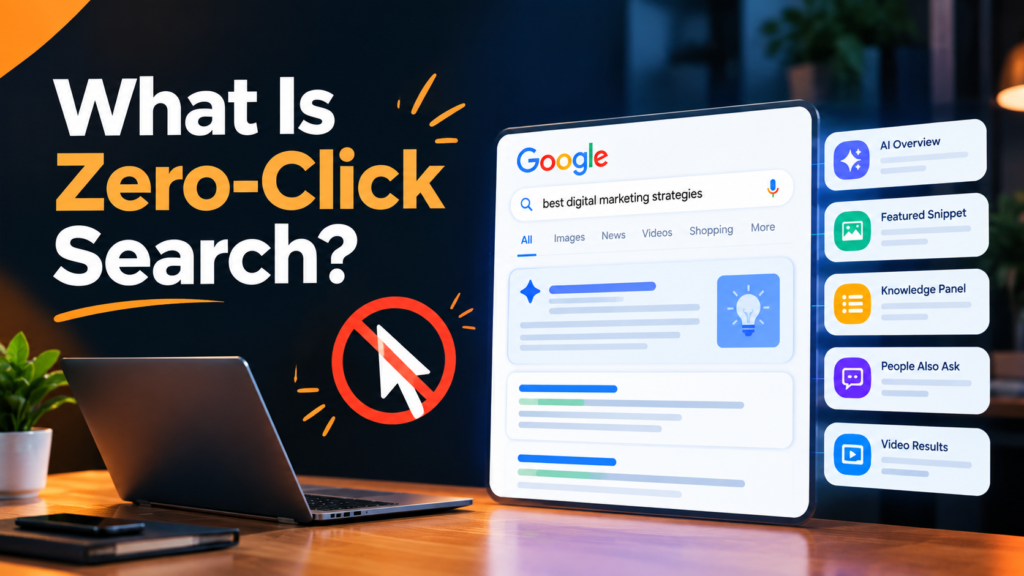
Google provides answers through several SERP features. These include Featured Snippets, which can display a short answer from a webpage; AI Overviews, which provide AI-generated summaries for eligible queries; Knowledge Panels, which present information about entities; People Also Ask, which expands related questions; and Local Packs, which show relevant local businesses. Other examples include calculators, weather information, currency conversions, definitions, and sports results.
The difference between traditional search and zero-click search is mainly what happens after the query. In traditional search, a user typically scans organic listings and clicks a webpage to continue their research. With a zero-click result, Google may provide enough information directly in the SERP for the user to complete that step without visiting another site.
This creates an important shift for businesses. A website may not receive a click, but its content or brand can still gain visibility if Google uses its information in a search feature. Therefore, SEO is increasingly about being discoverable throughout the search experience—not simply getting a blue-link ranking.
How Zero-Click Searches Work
The process behind a zero-click search starts when a user enters a query such as “What is local SEO?” or “weather in Delhi.” Google’s systems attempt to understand the user’s search intent—what information the person is actually looking for.
The search engine then determines which type of result can best satisfy that intent. Depending on the query, Google may display a featured snippet, AI Overview, knowledge panel, local results, calculator, or another direct-answer feature.
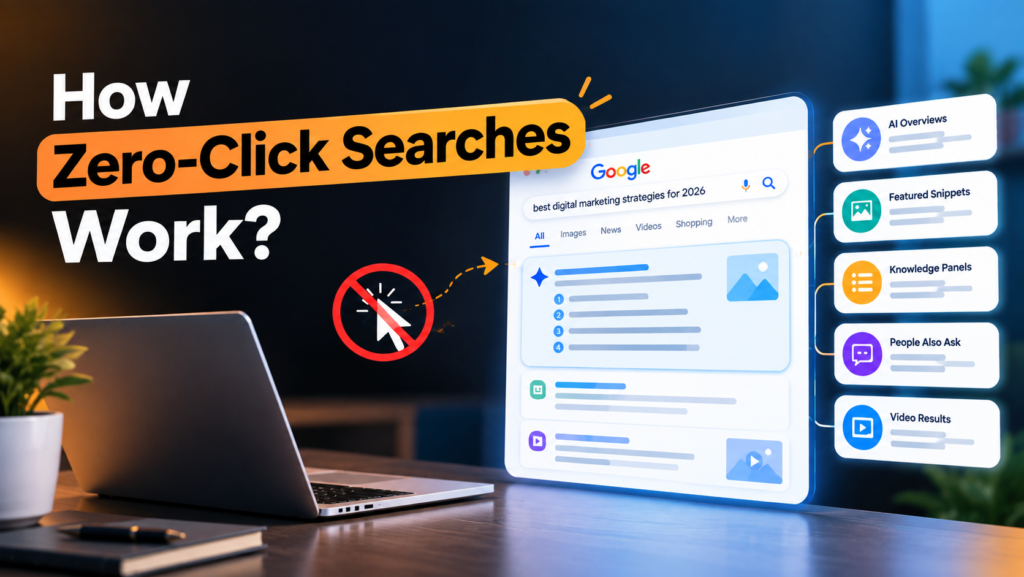
For example, someone searching “25% of 2,000” may receive the calculation directly in Google. Someone searching “best digital marketing agencies near me” may see local business results before traditional organic listings.
This is the core idea behind zero-click search: the user can receive useful information directly from the SERP rather than needing to open a webpage.
For marketers, this means creating content that clearly answers customer questions, demonstrates expertise, and provides information that search engines can understand. The objective isn’t simply to chase clicks—it is to build search visibility, brand recognition, and trust throughout the modern search journey.
Why Zero-Click Search Is Important for Businesses in 2026
The importance of zero-click search has grown because the way people use search engines is changing. Users increasingly expect quick, complete answers instead of browsing through several websites. In the first four months of 2026, 68.01% of Google searches in the U.S. ended without a click, according to SparkToro’s analysis of Similarweb clickstream data, compared with 60.45% in 2024.
AI is accelerating this change. Google reported that its AI Overviews had more than 2.5 billion monthly users by June 2026, showing how quickly AI-generated search experiences have become part of everyday search behavior. As search engines provide more information directly within the results page, businesses can no longer depend entirely on traditional blue-link rankings to attract potential customers.
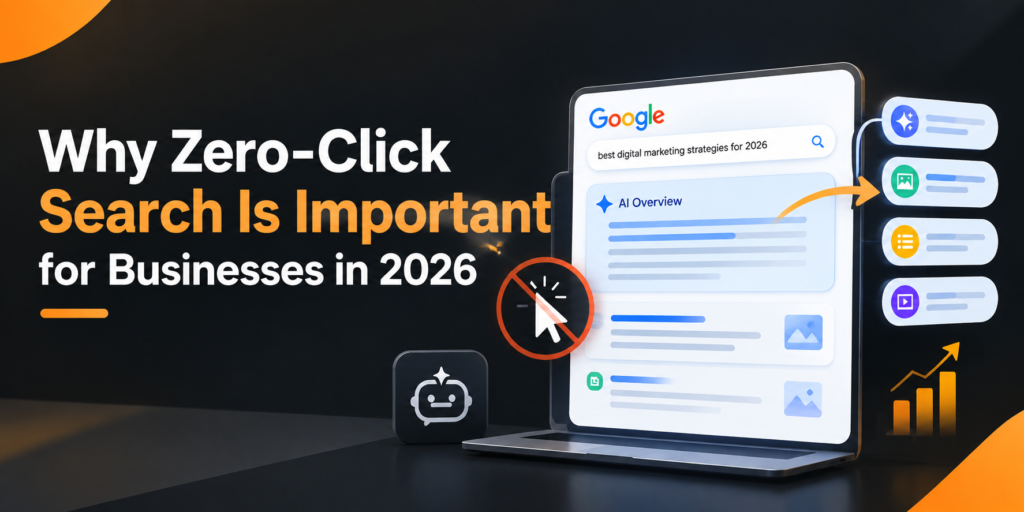
This doesn’t mean website traffic has become irrelevant. Instead, zero-click search changes where the first interaction with a brand can happen. A customer might see a company’s information in an AI Overview, discover it through a local result, read an answer from its content in a featured snippet, or encounter its brand while researching a product or service—all before visiting the website.
For digital marketers, this makes zero-click search a visibility and brand-awareness opportunity as well as a traffic challenge. Similarweb notes that appearing directly in search results can help consumers become familiar with a brand and build credibility, particularly through knowledge features and local search experiences.
Consider a simple example. Someone searches for “best digital marketing agency near me.” They may see local businesses, reviews, services, and contact information directly in the search results. Even if they don’t immediately click a website, seeing a business repeatedly during research can influence which brands they remember and investigate later.
This is why businesses should measure more than clicks in 2026. Zero-click search visibility can contribute to awareness, trust, branded searches, local discovery, and eventually conversions that happen through other channels.
The customer journey is becoming less linear: search → answer → brand discovery → consideration → conversion may happen across multiple touchpoints rather than through one website visit. Businesses that optimize their content, brand presence, local listings, and authority for this new search environment can remain visible even when the click itself doesn’t happen.
What Is a Zero-Click SERP?
A Zero-click SERP (Search Engine Results Page) is a search results page where users can find the information they need without visiting a website. Instead of relying only on traditional blue-link results, Google can display information directly through features such as featured snippets, AI Overviews, knowledge panels, local results, and other search elements. Google itself notes that Search can provide direct answers for many queries, including calculations, definitions, weather, sports, and other quick facts.
For example, if someone searches “What is digital marketing?”, Google may display a featured snippet containing a short explanation. Featured snippets are selected from web pages when Google’s systems determine that a concise section can answer the user’s question. This is a typical Zero-click SERP experience because the user may get the basic answer without clicking the source website.
Common Zero-Click SERP Features
Featured Snippets:
These provide a short answer, list, or other extract from a webpage directly in Google results. They can appear prominently when Google believes a page provides a useful answer.
AI Overviews:
Google’s AI-powered results can summarize information from multiple web sources and provide links to supporting pages. This creates another way for users to explore a topic without beginning with a traditional website click.
Knowledge Panels:
These display information about entities such as businesses, people, places, and organizations directly within Search.
Local Search Results:
For location-based searches, Google can show business information directly in Search and Maps. Local listings can include information such as business details, photos, reviews, and other information gathered from multiple sources.
People Also Ask:
These expandable questions help users discover answers to related queries without necessarily opening a webpage.
Reviews and Ratings:
Reviews can appear alongside business listings in Search and Maps, giving potential customers additional information before they visit a website. Google says business reviews can help businesses stand out in Search and Maps.
Why Businesses Should Optimize for SERP Visibility
The rise of the Zero-click SERP means ranking for a traditional organic position is only one part of search visibility. A business can potentially reach customers through snippets, local listings, reviews, AI-powered results, and other SERP features.
For digital marketers, the goal should therefore be broader than simply generating website clicks. Strong Zero-click SERP visibility can put a brand in front of potential customers during the research stage, build familiarity, and provide useful information at the exact moment someone has a question or commercial need.
In 2026, businesses should focus on being visible wherever the customer searches, while continuing to create valuable content that gives users a reason to visit the website when they want deeper information. Google also emphasizes that structured data can help its systems understand webpage content and potentially support richer search appearances.
Zero-Click SEO vs Traditional SEO
Traditional SEO and Zero-click SEO may look different, but they share the same fundamental goal: helping the right audience discover a business through search. The difference is where that visibility happens and how success is measured.
| Traditional SEO | Zero-Click SEO |
| Focuses heavily on website traffic | Focuses on search visibility |
| Targets organic clicks | Targets SERP exposure |
| Optimizes for rankings | Optimizes for SERP features |
| Measures clicks and traffic | Also considers impressions and visibility |
Traditional SEO generally focuses on improving organic rankings so users click through to a website. Businesses optimize pages, build relevant content, improve technical SEO, and target keywords to attract qualified visitors. These activities remain important because users still click when they want detailed information, compare products or services, read reviews, or make a purchase.
Zero-click SEO, on the other hand, expands the focus beyond the website visit. It aims to make a brand visible through featured snippets, local results, People Also Ask, knowledge panels, and AI-powered search experiences. This matters because Google is increasingly helping users explore information directly within Search. In 2026, Google says AI Mode has surpassed 1 billion monthly users globally, while AI Overviews have more than 2.5 billion monthly active users.
How the Goals Overlap
The two approaches aren’t competing strategies. In fact, Zero-click SEO often builds on the same foundations as traditional SEO: useful content, strong topical relevance, clear website structure, technical accessibility, authority, and a good understanding of search intent.
For example, a digital marketing agency might create an article answering “What is local SEO?” Traditional SEO would aim to rank that article and generate website visitors. A zero-click approach would also structure the answer clearly enough that Google could potentially use relevant content in a featured snippet or AI-powered search experience.
Google’s current AI Search direction also shows that clicks haven’t disappeared. Google says its AI experiences are designed to connect users with websites through prominent links and deeper exploration.
Why Businesses Should Adapt—Not Abandon Traditional SEO
Businesses shouldn’t replace traditional SEO with Zero-click SEO. Instead, they should combine them.
Think of it as a broader search strategy:
Visibility → Discovery → Trust → Click → Conversion
A user might first discover your brand through a SERP feature, later search your brand name, visit your website, compare your services, and eventually become a customer. Therefore, measuring only website traffic can miss important parts of the customer journey.
In 2026, the smarter approach is to optimize for both clicks and visibility. Continue creating valuable website content and improving organic rankings, while also making that content clear, authoritative, structured, and useful for modern SERP and AI search experiences.
The goal isn’t to choose between traditional SEO and Zero-click SEO—it’s to make your brand discoverable wherever your potential customers are searching.
What Is Zero-Click SEO?
Zero-click SEO is the practice of optimizing a website, brand, and online presence so they can gain visibility directly within search results—even when a user doesn’t click through to a website. Instead of focusing only on getting visitors, the strategy aims to make a business discoverable through features such as featured snippets, AI-powered answers, local results, knowledge panels, and other SERP elements.
This doesn’t mean traditional SEO is becoming irrelevant. Rather, Zero-click SEO expands the definition of search visibility. Google explains that featured snippets can show information extracted from a webpage directly in Search, while structured data helps Google understand page content and can make pages eligible for richer search appearances.
Key Elements of Zero-Click SEO
1. Search Intent
Understanding search intent is the starting point. A business needs to know whether someone wants an explanation, comparison, local business, product, or solution. Content should answer the actual question behind the search rather than simply repeating a keyword. Google notes that its systems can understand related terms and concepts even when a page doesn’t contain an exact match for every search word.
2. Structured Content
Clear headings, short paragraphs, lists, tables, FAQs, and logically organized information make content easier for users and search engines to understand. Structured data can also help Google interpret specific information on a page and potentially display it through supported search features.
3. Direct Answers
If a customer asks “What is local SEO?”, don’t make them read 800 words before finding the definition. Give a concise answer first and then provide deeper information. Google says featured snippets are selected when its systems determine that a short piece of a webpage can answer a user’s question.
4. Authority and Trust
Useful, accurate, original content is essential. Businesses should demonstrate expertise through detailed resources, author information, credible references, case studies, and consistently helpful content. The objective is to become a reliable source rather than simply inserting keywords into articles.
5. Local Optimization
For local businesses, Zero-click SEO also means making essential business information easy to understand and discover. Accurate business details, location information, hours, and appropriate LocalBusiness structured data can help Google understand a business’s presence in Search and Maps.
6. Brand Mentions
Your brand should be recognizable beyond your website. Consistent business information, genuine reviews, relevant publications, social profiles, and industry mentions can help strengthen your overall digital presence. The more consistently customers encounter your brand during research, the more opportunities you have to remain part of their consideration set.
Ultimately, Zero-click SEO isn’t about eliminating clicks. It’s about ensuring that your business can be seen, understood, and remembered before the click happens—and giving customers a strong reason to visit your website when they need more information.
Zero-Click Search Optimization: How to Get More Visibility
Zero-click search optimization is about making your content useful and visible directly within search results, even when users don’t immediately visit your website. The process starts with understanding what people want, answering their questions clearly, and structuring information so search engines can understand it. For businesses in 2026, this means optimizing not only for rankings but also for the different ways information can appear in Search.
Target Search Intent
The first step in zero-click search optimization is understanding search intent. A user searching “What is SEO?” has a different goal from someone searching “SEO agency near me” or “SEO services pricing.”
The four common intent categories are:
- Informational: Looking for knowledge or an answer.
- Navigational: Trying to find a specific website or brand.
- Commercial: Researching products, services, or businesses before making a decision.
- Transactional: Ready to take an action, such as purchasing or contacting a business.
Matching content to the correct intent increases its usefulness and relevance.
Answer Questions Directly
Users often want an answer quickly. Start important sections with concise explanations before moving into detailed information. Use question-based headings such as “What is Zero-Click SEO?” or “How does zero-click search work?”
Definitions, examples, bullet points, and short explanations make information easier to scan. This approach also creates clear passages that search systems can understand.
Optimize for Featured Snippets
Featured snippets can display a relevant passage from a webpage directly in Google Search. Google says its systems automatically determine whether a page is suitable for a featured snippet; there is no special markup that guarantees one.
To improve your content structure:
- Keep important answers concise.
- Use numbered lists for processes.
- Use bullet points for multiple items.
- Create comparison tables where useful.
- Answer specific questions clearly.
- Follow questions with practical explanations.
Use Structured Data
Structured data gives search engines standardized information about the content of a webpage. Google explains that structured data can help its systems understand page content and make pages eligible for supported richer search appearances.
Depending on the business and content, relevant types can include Article, Product, Organization, and LocalBusiness structured data. For example, Google says LocalBusiness markup can communicate information such as business hours and other business details.
Optimize for Local Search
For businesses serving a specific area, local visibility is a major part of zero-click search optimization. Keep your Google Business Profile accurate and complete, including business category, address, hours, and other relevant information. Google says local results are primarily influenced by relevance, distance, and prominence.
Encourage genuine customer reviews and respond professionally to them. Google specifically states that reviews can help businesses stand out, while incentivizing reviews is prohibited.
Location-specific service pages and locally relevant content can further clarify where and whom your business serves.
Build Topical Authority
Finally, create comprehensive topic clusters instead of publishing isolated articles. Cover a main subject through related guides, FAQs, comparisons, and supporting resources, then connect them with relevant internal links.
For example, a digital marketing agency could build a cluster around SEO with articles covering technical SEO, local SEO, keyword research, zero-click search, SEO audits, and content optimization.
The goal of zero-click search optimization isn’t simply to appear in one SERP feature. It’s to build a consistent, trustworthy presence across the search journey—so customers can discover your expertise whether they click your website or not.
How Businesses Can Still Get Customers From Zero-Click Searches
The rise of zero-click search doesn’t mean businesses have lost the ability to generate customers from search. It means the customer journey is changing. A potential customer may first discover a business through a featured snippet, AI Overview, local result, review, or another SERP feature before ever visiting its website. For marketers, the opportunity is to turn that visibility into brand recognition, trust, and eventually action.
Turn Search Visibility Into Brand Recognition
When your business appears repeatedly for relevant searches, people can become familiar with your brand even if they don’t click every time. For example, a local digital marketing agency that consistently appears for searches related to SEO, Google Ads, or social media marketing can build recognition among people researching those services.
The objective of zero-click search should therefore extend beyond traffic. Think about every search impression as a potential brand touchpoint.
Make Your Brand Name Visible
Where appropriate, create content that clearly communicates who you are, what you offer, and who you serve. Your brand name should be consistent across your website, business profiles, social platforms, directories, and other legitimate online mentions.
For example, instead of publishing a generic article titled “SEO Tips,” a business could create a detailed resource such as “SEO Tips for Small Businesses: A Practical Guide by [Brand Name].” Useful content combined with consistent branding can make the business easier to remember.
Use Strong Calls-to-Action
A user who discovers your business through zero-click search may need another reason to take action. Relevant calls-to-action can guide them toward the next step, such as:
- Get a free consultation
- Request a quote
- View our services
- Download the guide
- Contact our team
The CTA should match the user’s intent rather than interrupting informational content with an aggressive sales message.
Optimize Landing Pages for Users Who Do Click
Clicks still matter. When someone moves from Google to your website, the landing page should deliver what the search promised. Keep the message clear, demonstrate your expertise, provide evidence such as case studies or testimonials where appropriate, and make contacting the business simple.
This is where zero-click search and traditional SEO work together: SERP visibility creates the opportunity, while a useful website can turn that opportunity into a lead or customer.
Build Trust Through Reviews and Expertise
Trust is particularly important when customers are comparing unfamiliar businesses. Genuine reviews, useful educational content, transparent business information, author expertise, and consistent branding can help people evaluate whether a company is worth considering.
For local businesses, Google says reviews can help businesses stand out in Search and Maps. (support.google.com)
Combine SEO With Other Marketing Channels
Don’t treat zero-click search as a standalone strategy. Combine SEO with social media, local SEO, email marketing, paid advertising, and content marketing.
Someone might discover your brand through Google, follow you on Instagram, see a remarketing ad, read an email, and eventually contact your business. Modern customer journeys often involve multiple touchpoints.
The key is to make each channel reinforce the same brand message, offer, and customer experience. Zero-click visibility may begin the journey, but a coordinated digital marketing strategy can help move that customer from discovery → trust → consideration → conversion.
How AI Search Is Changing Zero-Click Search in 2026
Artificial intelligence is changing how people discover information online, and zero-click search is becoming more conversational and answer-focused as a result. Instead of entering a short keyword, users can now ask detailed questions, describe a problem, and continue with follow-up questions without starting a completely new search.
Google reported in May 2026 that AI Mode had surpassed 1 billion monthly users globally, with AI Mode queries more than doubling every quarter since its launch. Google also said AI Overviews had surpassed 2.5 billion monthly active users.
AI-Generated Answers and Summaries
AI Overviews and AI Mode can summarize information from multiple sources and provide links to supporting websites. This changes the traditional search journey from:
Search → Results → Click → Read
to something closer to:
Question → AI-generated answer → Follow-up questions → Source discovery → Action
Google says its generative AI features use information retrieved from its Search index and can show prominent links to relevant webpages supporting the response.
For businesses, this means content needs to be useful enough to be discovered and referenced within increasingly complex search experiences.
AI Overviews and Conversational Search
AI Overviews are also becoming more interactive. Google has connected AI Overviews with AI Mode so users can move from an initial answer into a conversational search experience and ask follow-up questions while maintaining context.
This makes zero-click search less about one isolated search result and more about becoming visible throughout a customer’s research journey.
The Growing Importance of Being a Trusted Source
When AI systems summarize information, the quality and credibility of the underlying sources matter. Businesses should therefore focus on original, useful, accurate, and experience-driven content rather than simply producing large volumes of keyword-focused pages.
Google’s 2026 guidance specifically recommends valuable, unique content and states that foundational SEO practices remain important for appearing in generative AI features.
Zero-Click Search and GEO
This is where Generative Engine Optimization (GEO) enters the conversation. GEO generally refers to efforts aimed at improving a brand or website’s visibility within generative AI search experiences. Google acknowledges the term but explains that, from its perspective, optimizing for generative AI search remains part of SEO because these experiences rely on Google’s core Search systems.
Therefore, zero-click search and GEO overlap: both focus on being discovered when users receive answers directly from search or AI interfaces.
Why Businesses Need Both Traditional SEO and AI Optimization
Businesses shouldn’t abandon traditional SEO. Google explicitly says SEO remains foundational to its generative AI search features.
The practical approach in 2026 is to create content that works across both environments:
Traditional SEO + Useful Content + Strong Authority + Clear Structure + AI Search Visibility
A business that optimizes only for website rankings may miss opportunities inside AI-powered discovery. Conversely, focusing only on AI visibility while neglecting technical SEO, website quality, and organic search can weaken the foundation needed to be discovered in the first place.
The future of zero-click search is therefore not simply about getting fewer clicks. It’s about making your brand visible, credible, and useful wherever customers are asking questions—whether that happens on a traditional SERP, an AI Overview, or a conversational search experience.
How to Measure Zero-Click SEO Performance
Measuring zero-click SEO requires looking beyond website traffic. If a customer sees your brand in an AI Overview, featured snippet, local result, or another SERP feature but doesn’t click, traditional traffic reports may not capture the full value of that interaction. In 2026, businesses should therefore combine search visibility metrics with brand and conversion data.
1. Search Impressions
Impressions show how often your website appears in Google Search. Google Search Console provides impressions, clicks, CTR, and average position as core performance metrics.
For zero-click SEO, increasing impressions for relevant searches can indicate that your content is becoming more visible—even when those impressions don’t always produce clicks.
2. SERP Visibility
Track how frequently your brand or content appears in important SERP features, including featured snippets, local results, People Also Ask, and other relevant search elements.
Don’t focus only on ranking position. Google itself recommends looking at trends in impressions and clicks rather than relying on average position alone.
3. Featured Snippet Appearances
Monitor whether your pages are appearing for queries that trigger featured snippets. These appearances can put your content in a prominent position and increase brand exposure without necessarily generating a website visit.
4. Brand Searches
Track searches containing your company or brand name. A rise in branded searches can indicate growing awareness, although it should not automatically be attributed to zero-click SEO alone.
Google Search Console now provides a Branded vs. Non-branded query filter, allowing marketers to analyze these two types of searches separately.
5. Local Visibility
For local businesses, monitor Google Business Profile performance alongside traditional SEO metrics. Google provides data such as profile views, searches, calls, website clicks, messages, bookings, and direction requests.
These metrics are particularly useful because someone may discover your business through local search and call or request directions without ever visiting your website.
6. Organic CTR
Organic CTR (Click-Through Rate) measures the percentage of impressions that result in clicks. Google defines CTR as clicks divided by impressions.
A high impression count with a low CTR can indicate that your content is visible but isn’t attracting enough clicks. However, in a zero-click SEO strategy, a lower CTR isn’t automatically negative if visibility and downstream conversions are also increasing.
7. Conversions and Leads
Ultimately, visibility matters because it can contribute to business results. Track form submissions, consultation requests, purchases, downloads, and other meaningful conversions using your analytics and CRM systems.
8. Phone Calls and Direction Requests
For local businesses, phone calls and direction requests can be valuable indicators of search-driven customer intent. Google Business Profile specifically reports both metrics.
9. Branded Traffic
Finally, compare branded and non-branded traffic over time. Google recommends using Search Console’s query filters to analyze branded versus non-branded performance and understand audience growth.
A useful measurement framework is:
Visibility → Impressions → Brand Awareness → Engagement → Leads → Conversions
This gives businesses a more complete picture of zero-click SEO performance instead of judging success only by website clicks.
Common Zero-Click SEO Mistakes Businesses Should Avoid
As search engines become more answer-focused, businesses need to rethink how they approach SEO. Zero-click SEO doesn’t replace traditional SEO, but it does require businesses to consider visibility across the entire search experience. Here are some common mistakes that can limit search visibility in 2026.
1. Focusing Only on Website Traffic
Website traffic is still an important metric, but it shouldn’t be the only one. A user may discover your brand through a featured snippet, local listing, AI Overview, or knowledge panel and remember the business without clicking immediately.
Track impressions, branded searches, local actions, leads, and conversions alongside traffic to understand the broader impact of zero-click SEO.
2. Ignoring SERP Features
Some businesses continue to focus exclusively on traditional organic rankings while overlooking the rest of the search results page.
Featured snippets, People Also Ask, local results, image results, reviews, and AI-powered search features can all influence how users discover information. Understanding which SERP features appear for your target queries can help you create content that fits those search experiences.
3. Writing Content Without Understanding Search Intent
A page can target the right keyword and still fail to satisfy the user.
Before creating content, ask: What does the searcher actually want? Someone searching “what is SEO?” needs educational information, while someone searching “SEO agency near me” has a much stronger local and commercial intent.
Matching content to intent is one of the foundations of effective zero-click SEO.
4. Providing Vague Answers
If your content takes several paragraphs to answer a simple question, users may move on. Start important sections with clear, concise answers and then provide supporting details, examples, data, and practical advice.
Question-based headings and direct answers can also make your content easier to scan.
5. Ignoring Local SEO
For businesses that serve specific locations, local search shouldn’t be an afterthought. Keep business information accurate, maintain your Google Business Profile, create relevant location-based content, and encourage genuine customer reviews.
Google says local results are primarily based on relevance, distance, and prominence. (support.google.com)
6. Creating Content Only for Keywords
Keyword placement alone doesn’t make content valuable. Search engines increasingly evaluate whether content genuinely helps users.
Instead of producing multiple thin articles around slightly different keywords, build comprehensive resources that answer related questions and solve real customer problems.
7. Neglecting Brand Authority
Visibility without trust may have limited business value. Demonstrate expertise through original research, practical examples, case studies, author expertise, accurate information, and consistent business details across relevant platforms.
Your objective should be to become a recognizable and reliable source within your industry.
8. Failing to Update Outdated Content
Information, statistics, products, services, and search results change over time. An article containing outdated figures or old recommendations can quickly lose usefulness.
Review important content regularly, update statistics and examples, remove obsolete information, and make sure the page still satisfies the searcher’s intent.
Avoiding these mistakes allows businesses to build a more complete zero-click SEO strategy—one that focuses not only on ranking and traffic, but also on visibility, relevance, trust, brand recognition, and measurable business outcomes.
Zero-Click Search Strategy for Businesses in 2026
Winning in search in 2026 is no longer just about getting users to click your website. Businesses also need to make sure their brand, answers, products, and services are visible directly within search results. With Google’s AI-powered search experiences expanding rapidly, this makes zero-click search optimization an important part of a modern SEO strategy. Google says AI Overviews now reach more than 2.5 billion monthly active users, while AI Mode has surpassed 1 billion monthly active users.
A simple strategy businesses can follow is:
Research → Create → Optimize → Build Authority → Measure → Improve
1. Research Zero-Click Opportunities
Start by finding searches where Google can provide an answer directly on the SERP. Look for informational queries, FAQs, “how to” searches, definitions, comparisons, local searches, and questions related to your products or services.
Use Google Search, Search Console, keyword research tools, People Also Ask, and competitor SERP analysis to identify questions your customers are already asking. The goal is to discover opportunities where your business can provide a useful answer before the customer even visits a website.
2. Create Answer-Focused Content
Once you know what your audience is searching for, create content that answers those questions clearly and quickly. Put the direct answer near the beginning of the relevant section, then provide supporting details, examples, statistics, and practical advice.
Question-based headings, short paragraphs, bullet points, tables, FAQs, and step-by-step explanations can make information easier for both users and search engines to understand.
3. Optimize for SERP Features
Next, optimize your content for relevant search appearances such as featured snippets, local results, product information, and other supported search features. Google explains that structured data helps it understand page content and can make pages eligible for certain richer search appearances.
However, structured data is not a guarantee of a particular search appearance. Focus first on creating accurate, useful, crawlable content.
4. Build Brand Authority
Visibility becomes more valuable when users recognize and trust your brand. Strengthen authority through original content, expert insights, genuine reviews, relevant mentions, consistent business information, and a strong presence across appropriate channels.
For zero-click search, brand recognition matters because a user may see your business in an answer or search feature without immediately clicking your website.
5. Measure What Matters
Don’t measure success only through clicks. Track impressions, SERP visibility, featured-result appearances where measurable, branded searches, organic CTR, leads, calls, direction requests, and conversions.
Google is also adding new tools and insights for website owners to understand performance in AI-powered Search.
6. Improve and Update Continuously
Search behavior changes quickly, especially as AI changes how people formulate questions. Review your important pages regularly, update outdated statistics and information, add new customer questions, and improve weak answers.
The goal of zero-click search strategy is not to replace traditional SEO. It is to expand your definition of search visibility—from simply earning a click to becoming a trusted answer and recognizable brand throughout the customer journey.
Conclusion
Zero-click search is changing the way businesses should think about SEO. Instead of assuming that every successful search must end with a website visit, businesses now need to consider how their brand appears throughout the search experience. Featured snippets, local results, People Also Ask, knowledge-based results, AI Overviews, and other SERP features can provide users with information before they ever click a traditional organic result.
This does not mean that website traffic is no longer valuable. Clicks, organic traffic, leads, and conversions remain important business outcomes. However, they are no longer the only indicators of search visibility. A potential customer may discover your brand through a search result, remember your business name, check your reviews later, search for your brand directly, or contact you through another channel.
That is why Zero-click search optimization should work alongside traditional SEO rather than replace it. Businesses should create content that directly answers customer questions, understand search intent, optimize relevant SERP features, strengthen local visibility, build topical authority, and maintain technically sound websites.
The Zero-click SERP is becoming an increasingly important part of the customer journey. Businesses that focus only on ranking blue links can miss opportunities to appear in the wider search ecosystem. Visibility, relevance, trust, and brand recognition can all contribute to how customers perceive a business before they visit its website.
At the same time, Zero-click SEO should ultimately support business growth—not just search visibility. Strong conversion pathways are essential. Once people discover your brand, make it easy for them to take the next step through clear calls to action, optimized landing pages, contact options, product pages, booking forms, phone calls, or other relevant conversion points.
The shift is already being accelerated by AI. Google reports that AI Overviews have more than 2.5 billion monthly active users and AI Mode has surpassed 1 billion monthly active users. Google also states that its AI search features continue to rely on foundational SEO practices such as technical accessibility, useful content, internal linking, and up-to-date business information.
For businesses in 2026, the goal is therefore broader than simply “get the click.” The goal is to be visible, be useful, build trust, and create a clear path from discovery to conversion.
As search continues to become more conversational, visual, personalized, and AI-powered, businesses that continuously adapt their content and SEO strategies will be better positioned to stay visible wherever their customers are searching.
Suggested FAQ Section
Frequently Asked Questions About Zero-Click Search
What is zero-click search?
A zero-click search occurs when a user gets the information they need directly on the search results page without clicking through to another website. Common examples include featured snippets, AI Overviews, knowledge panels, local results, calculators, and direct answers. For businesses, this means search visibility can matter even when a search does not generate an immediate website visit.
Why are zero-click searches increasing in 2026?
Zero-click searches are increasing as search engines provide more information directly within the SERP and introduce AI-powered experiences. AI Overviews and conversational search can summarize information and help users explore topics without relying exclusively on traditional blue-link results. As search becomes more direct and interactive, businesses need to optimize for visibility across different SERP features.
How does zero-click search affect SEO?
Zero-click search expands the purpose of SEO beyond generating website clicks. Traditional rankings and organic traffic remain important, but businesses should also consider impressions, SERP visibility, brand searches, local exposure, and appearances in relevant search features. SEO strategies increasingly need to account for how users discover and interact with information directly within search results.
What is Zero-click SEO?
Zero-click SEO is the practice of optimizing content and online presence so a business can gain visibility in search results even when users do not immediately click a website. It includes optimizing for search intent, featured snippets, relevant SERP features, local search, structured content, brand authority, and clear answers to customer questions.
What is a Zero-click SERP?
A Zero-click SERP is a search results page where users can find useful information without needing to visit a website. It may contain features such as featured snippets, AI-generated summaries, knowledge panels, People Also Ask, local results, and other direct-answer elements. Businesses can optimize their content to increase their chances of appearing in relevant search features.
How can businesses optimize for zero-click searches?
Businesses can focus on customer search intent and create clear, answer-focused content. Useful tactics include answering common questions directly, using descriptive headings, organizing information with lists and tables, maintaining accurate local business information, using appropriate structured data, building topical authority, and regularly updating important content. The objective of zero-click search optimization is to make valuable information easy for search engines and users to understand.
Can zero-click searches still generate customers?
Yes. A search does not always need to produce an immediate website click to contribute to the customer journey. Someone may discover a business through a local result, AI-generated answer, review, or other search feature and later search for the brand, visit its website directly, call the business, or make a purchase through another channel. Strong branding, trust signals, and clear conversion pathways can help turn search visibility into business opportunities.
What is the difference between zero-click SEO and traditional SEO?
Traditional SEO has historically placed significant emphasis on improving organic rankings and generating website traffic. Zero-click SEO expands that approach by focusing on visibility within the search results themselves.
| Traditional SEO | Zero-click SEO |
| Strong focus on organic rankings | Strong focus on search visibility |
| Emphasizes website clicks | Also considers SERP exposure |
| Targets organic traffic | Targets answers and SERP features |
| Measures clicks and sessions | Also considers impressions, visibility and brand searches |
| Optimizes webpages | Optimizes content and broader search presence |
In practice, businesses do not have to choose between the two. A modern SEO strategy can combine traditional SEO with Zero-click SEO to build visibility, attract qualified visitors, strengthen brand recognition, and support conversions.
Introduction
Search behavior has changed significantly, and zero-click search is becoming one of the most important developments for digital marketers in 2026. A zero-click search happens when a user finds the information they need directly on the search results page without clicking through to a website. This can happen through featured snippets, knowledge panels, local results, People Also Ask, and increasingly, AI-generated search experiences.
The scale of this shift is significant. According to 2026 research from SparkToro, based on Similarweb clickstream data, 68.01% of Google searches in the U.S. ended without a click during the first four months of 2026, compared with 60.45% in 2024. This doesn’t mean people have stopped searching—it means more of the search journey is being completed directly within Google.
That makes zero-click search particularly important for businesses. Google is increasingly using AI and SERP features to provide immediate answers, helping users find information without necessarily visiting the original source. Google reported that AI Overviews had reached more than 2 billion monthly users across 200+ countries and territories and 40 languages by July 2025. Google also reported that AI Overviews were driving more than a 10% increase in Google usage for the types of queries where they appear in the U.S. and India.
For marketers, this changes the definition of search visibility. Ranking on page one and generating website clicks are still valuable, but they are no longer the entire story. A business can now gain exposure when its information, brand, products, or expertise appears directly in the search experience.
The challenge is clear: zero-click search can reduce opportunities for traditional organic traffic, while simultaneously creating new opportunities for brand visibility and customer discovery. In 2026, businesses need to think beyond simply earning clicks. The goal is to become a trusted, visible source wherever potential customers are searching—even when that search doesn’t end with a website visit.
What Is Zero-Click Search?
A zero-click search occurs when a user searches for something on Google but gets the information they need directly on the search engine results page (SERP), without clicking on a website. In simple terms, the search is completed without a traditional website visit. For digital marketers, understanding zero-click search is important because visibility can now happen inside the search results themselves.
Google provides answers through several SERP features. These include Featured Snippets, which can display a short answer from a webpage; AI Overviews, which provide AI-generated summaries for eligible queries; Knowledge Panels, which present information about entities; People Also Ask, which expands related questions; and Local Packs, which show relevant local businesses. Other examples include calculators, weather information, currency conversions, definitions, and sports results.
The difference between traditional search and zero-click search is mainly what happens after the query. In traditional search, a user typically scans organic listings and clicks a webpage to continue their research. With a zero-click result, Google may provide enough information directly in the SERP for the user to complete that step without visiting another site.
This creates an important shift for businesses. A website may not receive a click, but its content or brand can still gain visibility if Google uses its information in a search feature. Therefore, SEO is increasingly about being discoverable throughout the search experience—not simply getting a blue-link ranking.
How Zero-Click Searches Work
The process behind a zero-click search starts when a user enters a query such as “What is local SEO?” or “weather in Delhi.” Google’s systems attempt to understand the user’s search intent—what information the person is actually looking for.
The search engine then determines which type of result can best satisfy that intent. Depending on the query, Google may display a featured snippet, AI Overview, knowledge panel, local results, calculator, or another direct-answer feature.
For example, someone searching “25% of 2,000” may receive the calculation directly in Google. Someone searching “best digital marketing agencies near me” may see local business results before traditional organic listings.
This is the core idea behind zero-click search: the user can receive useful information directly from the SERP rather than needing to open a webpage.
For marketers, this means creating content that clearly answers customer questions, demonstrates expertise, and provides information that search engines can understand. The objective isn’t simply to chase clicks—it is to build search visibility, brand recognition, and trust throughout the modern search journey.
Why Zero-Click Search Is Important for Businesses in 2026
The importance of zero-click search has grown because the way people use search engines is changing. Users increasingly expect quick, complete answers instead of browsing through several websites. In the first four months of 2026, 68.01% of Google searches in the U.S. ended without a click, according to SparkToro’s analysis of Similarweb clickstream data, compared with 60.45% in 2024.
AI is accelerating this change. Google reported that its AI Overviews had more than 2.5 billion monthly users by June 2026, showing how quickly AI-generated search experiences have become part of everyday search behavior. As search engines provide more information directly within the results page, businesses can no longer depend entirely on traditional blue-link rankings to attract potential customers.
This doesn’t mean website traffic has become irrelevant. Instead, zero-click search changes where the first interaction with a brand can happen. A customer might see a company’s information in an AI Overview, discover it through a local result, read an answer from its content in a featured snippet, or encounter its brand while researching a product or service—all before visiting the website.
For digital marketers, this makes zero-click search a visibility and brand-awareness opportunity as well as a traffic challenge. Similarweb notes that appearing directly in search results can help consumers become familiar with a brand and build credibility, particularly through knowledge features and local search experiences.
Consider a simple example. Someone searches for “best digital marketing agency near me.” They may see local businesses, reviews, services, and contact information directly in the search results. Even if they don’t immediately click a website, seeing a business repeatedly during research can influence which brands they remember and investigate later.
This is why businesses should measure more than clicks in 2026. Zero-click search visibility can contribute to awareness, trust, branded searches, local discovery, and eventually conversions that happen through other channels.
The customer journey is becoming less linear: search → answer → brand discovery → consideration → conversion may happen across multiple touchpoints rather than through one website visit. Businesses that optimize their content, brand presence, local listings, and authority for this new search environment can remain visible even when the click itself doesn’t happen.
What Is a Zero-Click SERP?
A Zero-click SERP (Search Engine Results Page) is a search results page where users can find the information they need without visiting a website. Instead of relying only on traditional blue-link results, Google can display information directly through features such as featured snippets, AI Overviews, knowledge panels, local results, and other search elements. Google itself notes that Search can provide direct answers for many queries, including calculations, definitions, weather, sports, and other quick facts.
For example, if someone searches “What is digital marketing?”, Google may display a featured snippet containing a short explanation. Featured snippets are selected from web pages when Google’s systems determine that a concise section can answer the user’s question. This is a typical Zero-click SERP experience because the user may get the basic answer without clicking the source website.
Common Zero-Click SERP Features
Featured Snippets:
These provide a short answer, list, or other extract from a webpage directly in Google results. They can appear prominently when Google believes a page provides a useful answer.
AI Overviews:
Google’s AI-powered results can summarize information from multiple web sources and provide links to supporting pages. This creates another way for users to explore a topic without beginning with a traditional website click.
Knowledge Panels:
These display information about entities such as businesses, people, places, and organizations directly within Search.
Local Search Results:
For location-based searches, Google can show business information directly in Search and Maps. Local listings can include information such as business details, photos, reviews, and other information gathered from multiple sources.
People Also Ask:
These expandable questions help users discover answers to related queries without necessarily opening a webpage.
Reviews and Ratings:
Reviews can appear alongside business listings in Search and Maps, giving potential customers additional information before they visit a website. Google says business reviews can help businesses stand out in Search and Maps.
Why Businesses Should Optimize for SERP Visibility
The rise of the Zero-click SERP means ranking for a traditional organic position is only one part of search visibility. A business can potentially reach customers through snippets, local listings, reviews, AI-powered results, and other SERP features.
For digital marketers, the goal should therefore be broader than simply generating website clicks. Strong Zero-click SERP visibility can put a brand in front of potential customers during the research stage, build familiarity, and provide useful information at the exact moment someone has a question or commercial need.
In 2026, businesses should focus on being visible wherever the customer searches, while continuing to create valuable content that gives users a reason to visit the website when they want deeper information. Google also emphasizes that structured data can help its systems understand webpage content and potentially support richer search appearances.
Zero-Click SEO vs Traditional SEO
Traditional SEO and Zero-click SEO may look different, but they share the same fundamental goal: helping the right audience discover a business through search. The difference is where that visibility happens and how success is measured.
| Traditional SEO | Zero-Click SEO |
| Focuses heavily on website traffic | Focuses on search visibility |
| Targets organic clicks | Targets SERP exposure |
| Optimizes for rankings | Optimizes for SERP features |
| Measures clicks and traffic | Also considers impressions and visibility |
Traditional SEO generally focuses on improving organic rankings so users click through to a website. Businesses optimize pages, build relevant content, improve technical SEO, and target keywords to attract qualified visitors. These activities remain important because users still click when they want detailed information, compare products or services, read reviews, or make a purchase.
Zero-click SEO, on the other hand, expands the focus beyond the website visit. It aims to make a brand visible through featured snippets, local results, People Also Ask, knowledge panels, and AI-powered search experiences. This matters because Google is increasingly helping users explore information directly within Search. In 2026, Google says AI Mode has surpassed 1 billion monthly users globally, while AI Overviews have more than 2.5 billion monthly active users.
How the Goals Overlap
The two approaches aren’t competing strategies. In fact, Zero-click SEO often builds on the same foundations as traditional SEO: useful content, strong topical relevance, clear website structure, technical accessibility, authority, and a good understanding of search intent.
For example, a digital marketing agency might create an article answering “What is local SEO?” Traditional SEO would aim to rank that article and generate website visitors. A zero-click approach would also structure the answer clearly enough that Google could potentially use relevant content in a featured snippet or AI-powered search experience.
Google’s current AI Search direction also shows that clicks haven’t disappeared. Google says its AI experiences are designed to connect users with websites through prominent links and deeper exploration.
Why Businesses Should Adapt—Not Abandon Traditional SEO
Businesses shouldn’t replace traditional SEO with Zero-click SEO. Instead, they should combine them.
Think of it as a broader search strategy:
Visibility → Discovery → Trust → Click → Conversion
A user might first discover your brand through a SERP feature, later search your brand name, visit your website, compare your services, and eventually become a customer. Therefore, measuring only website traffic can miss important parts of the customer journey.
In 2026, the smarter approach is to optimize for both clicks and visibility. Continue creating valuable website content and improving organic rankings, while also making that content clear, authoritative, structured, and useful for modern SERP and AI search experiences.
The goal isn’t to choose between traditional SEO and Zero-click SEO—it’s to make your brand discoverable wherever your potential customers are searching.
What Is Zero-Click SEO?
Zero-click SEO is the practice of optimizing a website, brand, and online presence so they can gain visibility directly within search results—even when a user doesn’t click through to a website. Instead of focusing only on getting visitors, the strategy aims to make a business discoverable through features such as featured snippets, AI-powered answers, local results, knowledge panels, and other SERP elements.
This doesn’t mean traditional SEO is becoming irrelevant. Rather, Zero-click SEO expands the definition of search visibility. Google explains that featured snippets can show information extracted from a webpage directly in Search, while structured data helps Google understand page content and can make pages eligible for richer search appearances.
Key Elements of Zero-Click SEO
1. Search Intent
Understanding search intent is the starting point. A business needs to know whether someone wants an explanation, comparison, local business, product, or solution. Content should answer the actual question behind the search rather than simply repeating a keyword. Google notes that its systems can understand related terms and concepts even when a page doesn’t contain an exact match for every search word.
2. Structured Content
Clear headings, short paragraphs, lists, tables, FAQs, and logically organized information make content easier for users and search engines to understand. Structured data can also help Google interpret specific information on a page and potentially display it through supported search features.
3. Direct Answers
If a customer asks “What is local SEO?”, don’t make them read 800 words before finding the definition. Give a concise answer first and then provide deeper information. Google says featured snippets are selected when its systems determine that a short piece of a webpage can answer a user’s question.
4. Authority and Trust
Useful, accurate, original content is essential. Businesses should demonstrate expertise through detailed resources, author information, credible references, case studies, and consistently helpful content. The objective is to become a reliable source rather than simply inserting keywords into articles.
5. Local Optimization
For local businesses, Zero-click SEO also means making essential business information easy to understand and discover. Accurate business details, location information, hours, and appropriate LocalBusiness structured data can help Google understand a business’s presence in Search and Maps.
6. Brand Mentions
Your brand should be recognizable beyond your website. Consistent business information, genuine reviews, relevant publications, social profiles, and industry mentions can help strengthen your overall digital presence. The more consistently customers encounter your brand during research, the more opportunities you have to remain part of their consideration set.
Ultimately, Zero-click SEO isn’t about eliminating clicks. It’s about ensuring that your business can be seen, understood, and remembered before the click happens—and giving customers a strong reason to visit your website when they need more information.
Zero-Click Search Optimization: How to Get More Visibility
Zero-click search optimization is about making your content useful and visible directly within search results, even when users don’t immediately visit your website. The process starts with understanding what people want, answering their questions clearly, and structuring information so search engines can understand it. For businesses in 2026, this means optimizing not only for rankings but also for the different ways information can appear in Search.
Target Search Intent
The first step in zero-click search optimization is understanding search intent. A user searching “What is SEO?” has a different goal from someone searching “SEO agency near me” or “SEO services pricing.”
The four common intent categories are:
- Informational: Looking for knowledge or an answer.
- Navigational: Trying to find a specific website or brand.
- Commercial: Researching products, services, or businesses before making a decision.
- Transactional: Ready to take an action, such as purchasing or contacting a business.
Matching content to the correct intent increases its usefulness and relevance.
Answer Questions Directly
Users often want an answer quickly. Start important sections with concise explanations before moving into detailed information. Use question-based headings such as “What is Zero-Click SEO?” or “How does zero-click search work?”
Definitions, examples, bullet points, and short explanations make information easier to scan. This approach also creates clear passages that search systems can understand.
Optimize for Featured Snippets
Featured snippets can display a relevant passage from a webpage directly in Google Search. Google says its systems automatically determine whether a page is suitable for a featured snippet; there is no special markup that guarantees one.
To improve your content structure:
- Keep important answers concise.
- Use numbered lists for processes.
- Use bullet points for multiple items.
- Create comparison tables where useful.
- Answer specific questions clearly.
- Follow questions with practical explanations.
Use Structured Data
Structured data gives search engines standardized information about the content of a webpage. Google explains that structured data can help its systems understand page content and make pages eligible for supported richer search appearances.
Depending on the business and content, relevant types can include Article, Product, Organization, and LocalBusiness structured data. For example, Google says LocalBusiness markup can communicate information such as business hours and other business details.
Optimize for Local Search
For businesses serving a specific area, local visibility is a major part of zero-click search optimization. Keep your Google Business Profile accurate and complete, including business category, address, hours, and other relevant information. Google says local results are primarily influenced by relevance, distance, and prominence.
Encourage genuine customer reviews and respond professionally to them. Google specifically states that reviews can help businesses stand out, while incentivizing reviews is prohibited.
Location-specific service pages and locally relevant content can further clarify where and whom your business serves.
Build Topical Authority
Finally, create comprehensive topic clusters instead of publishing isolated articles. Cover a main subject through related guides, FAQs, comparisons, and supporting resources, then connect them with relevant internal links.
For example, a digital marketing agency could build a cluster around SEO with articles covering technical SEO, local SEO, keyword research, zero-click search, SEO audits, and content optimization.
The goal of zero-click search optimization isn’t simply to appear in one SERP feature. It’s to build a consistent, trustworthy presence across the search journey—so customers can discover your expertise whether they click your website or not.
How Businesses Can Still Get Customers From Zero-Click Searches
The rise of zero-click search doesn’t mean businesses have lost the ability to generate customers from search. It means the customer journey is changing. A potential customer may first discover a business through a featured snippet, AI Overview, local result, review, or another SERP feature before ever visiting its website. For marketers, the opportunity is to turn that visibility into brand recognition, trust, and eventually action.
Turn Search Visibility Into Brand Recognition
When your business appears repeatedly for relevant searches, people can become familiar with your brand even if they don’t click every time. For example, a local digital marketing agency that consistently appears for searches related to SEO, Google Ads, or social media marketing can build recognition among people researching those services.
The objective of zero-click search should therefore extend beyond traffic. Think about every search impression as a potential brand touchpoint.
Make Your Brand Name Visible
Where appropriate, create content that clearly communicates who you are, what you offer, and who you serve. Your brand name should be consistent across your website, business profiles, social platforms, directories, and other legitimate online mentions.
For example, instead of publishing a generic article titled “SEO Tips,” a business could create a detailed resource such as “SEO Tips for Small Businesses: A Practical Guide by [Brand Name].” Useful content combined with consistent branding can make the business easier to remember.
Use Strong Calls-to-Action
A user who discovers your business through zero-click search may need another reason to take action. Relevant calls-to-action can guide them toward the next step, such as:
- Get a free consultation
- Request a quote
- View our services
- Download the guide
- Contact our team
The CTA should match the user’s intent rather than interrupting informational content with an aggressive sales message.
Optimize Landing Pages for Users Who Do Click
Clicks still matter. When someone moves from Google to your website, the landing page should deliver what the search promised. Keep the message clear, demonstrate your expertise, provide evidence such as case studies or testimonials where appropriate, and make contacting the business simple.
This is where zero-click search and traditional SEO work together: SERP visibility creates the opportunity, while a useful website can turn that opportunity into a lead or customer.
Build Trust Through Reviews and Expertise
Trust is particularly important when customers are comparing unfamiliar businesses. Genuine reviews, useful educational content, transparent business information, author expertise, and consistent branding can help people evaluate whether a company is worth considering.
For local businesses, Google says reviews can help businesses stand out in Search and Maps. (support.google.com)
Combine SEO With Other Marketing Channels
Don’t treat zero-click search as a standalone strategy. Combine SEO with social media, local SEO, email marketing, paid advertising, and content marketing.
Someone might discover your brand through Google, follow you on Instagram, see a remarketing ad, read an email, and eventually contact your business. Modern customer journeys often involve multiple touchpoints.
The key is to make each channel reinforce the same brand message, offer, and customer experience. Zero-click visibility may begin the journey, but a coordinated digital marketing strategy can help move that customer from discovery → trust → consideration → conversion.
How AI Search Is Changing Zero-Click Search in 2026
Artificial intelligence is changing how people discover information online, and zero-click search is becoming more conversational and answer-focused as a result. Instead of entering a short keyword, users can now ask detailed questions, describe a problem, and continue with follow-up questions without starting a completely new search.
Google reported in May 2026 that AI Mode had surpassed 1 billion monthly users globally, with AI Mode queries more than doubling every quarter since its launch. Google also said AI Overviews had surpassed 2.5 billion monthly active users.
AI-Generated Answers and Summaries
AI Overviews and AI Mode can summarize information from multiple sources and provide links to supporting websites. This changes the traditional search journey from:
Search → Results → Click → Read
to something closer to:
Question → AI-generated answer → Follow-up questions → Source discovery → Action
Google says its generative AI features use information retrieved from its Search index and can show prominent links to relevant webpages supporting the response.
For businesses, this means content needs to be useful enough to be discovered and referenced within increasingly complex search experiences.
AI Overviews and Conversational Search
AI Overviews are also becoming more interactive. Google has connected AI Overviews with AI Mode so users can move from an initial answer into a conversational search experience and ask follow-up questions while maintaining context.
This makes zero-click search less about one isolated search result and more about becoming visible throughout a customer’s research journey.
The Growing Importance of Being a Trusted Source
When AI systems summarize information, the quality and credibility of the underlying sources matter. Businesses should therefore focus on original, useful, accurate, and experience-driven content rather than simply producing large volumes of keyword-focused pages.
Google’s 2026 guidance specifically recommends valuable, unique content and states that foundational SEO practices remain important for appearing in generative AI features.
Zero-Click Search and GEO
This is where Generative Engine Optimization (GEO) enters the conversation. GEO generally refers to efforts aimed at improving a brand or website’s visibility within generative AI search experiences. Google acknowledges the term but explains that, from its perspective, optimizing for generative AI search remains part of SEO because these experiences rely on Google’s core Search systems.
Therefore, zero-click search and GEO overlap: both focus on being discovered when users receive answers directly from search or AI interfaces.
Why Businesses Need Both Traditional SEO and AI Optimization
Businesses shouldn’t abandon traditional SEO. Google explicitly says SEO remains foundational to its generative AI search features.
The practical approach in 2026 is to create content that works across both environments:
Traditional SEO + Useful Content + Strong Authority + Clear Structure + AI Search Visibility
A business that optimizes only for website rankings may miss opportunities inside AI-powered discovery. Conversely, focusing only on AI visibility while neglecting technical SEO, website quality, and organic search can weaken the foundation needed to be discovered in the first place.
The future of zero-click search is therefore not simply about getting fewer clicks. It’s about making your brand visible, credible, and useful wherever customers are asking questions—whether that happens on a traditional SERP, an AI Overview, or a conversational search experience.
How to Measure Zero-Click SEO Performance
Measuring zero-click SEO requires looking beyond website traffic. If a customer sees your brand in an AI Overview, featured snippet, local result, or another SERP feature but doesn’t click, traditional traffic reports may not capture the full value of that interaction. In 2026, businesses should therefore combine search visibility metrics with brand and conversion data.
1. Search Impressions
Impressions show how often your website appears in Google Search. Google Search Console provides impressions, clicks, CTR, and average position as core performance metrics.
For zero-click SEO, increasing impressions for relevant searches can indicate that your content is becoming more visible—even when those impressions don’t always produce clicks.
2. SERP Visibility
Track how frequently your brand or content appears in important SERP features, including featured snippets, local results, People Also Ask, and other relevant search elements.
Don’t focus only on ranking position. Google itself recommends looking at trends in impressions and clicks rather than relying on average position alone.
3. Featured Snippet Appearances
Monitor whether your pages are appearing for queries that trigger featured snippets. These appearances can put your content in a prominent position and increase brand exposure without necessarily generating a website visit.
4. Brand Searches
Track searches containing your company or brand name. A rise in branded searches can indicate growing awareness, although it should not automatically be attributed to zero-click SEO alone.
Google Search Console now provides a Branded vs. Non-branded query filter, allowing marketers to analyze these two types of searches separately.
5. Local Visibility
For local businesses, monitor Google Business Profile performance alongside traditional SEO metrics. Google provides data such as profile views, searches, calls, website clicks, messages, bookings, and direction requests.
These metrics are particularly useful because someone may discover your business through local search and call or request directions without ever visiting your website.
6. Organic CTR
Organic CTR (Click-Through Rate) measures the percentage of impressions that result in clicks. Google defines CTR as clicks divided by impressions.
A high impression count with a low CTR can indicate that your content is visible but isn’t attracting enough clicks. However, in a zero-click SEO strategy, a lower CTR isn’t automatically negative if visibility and downstream conversions are also increasing.
7. Conversions and Leads
Ultimately, visibility matters because it can contribute to business results. Track form submissions, consultation requests, purchases, downloads, and other meaningful conversions using your analytics and CRM systems.
8. Phone Calls and Direction Requests
For local businesses, phone calls and direction requests can be valuable indicators of search-driven customer intent. Google Business Profile specifically reports both metrics.
9. Branded Traffic
Finally, compare branded and non-branded traffic over time. Google recommends using Search Console’s query filters to analyze branded versus non-branded performance and understand audience growth.
A useful measurement framework is:
Visibility → Impressions → Brand Awareness → Engagement → Leads → Conversions
This gives businesses a more complete picture of zero-click SEO performance instead of judging success only by website clicks.
Common Zero-Click SEO Mistakes Businesses Should Avoid
As search engines become more answer-focused, businesses need to rethink how they approach SEO. Zero-click SEO doesn’t replace traditional SEO, but it does require businesses to consider visibility across the entire search experience. Here are some common mistakes that can limit search visibility in 2026.
1. Focusing Only on Website Traffic
Website traffic is still an important metric, but it shouldn’t be the only one. A user may discover your brand through a featured snippet, local listing, AI Overview, or knowledge panel and remember the business without clicking immediately.
Track impressions, branded searches, local actions, leads, and conversions alongside traffic to understand the broader impact of zero-click SEO.
2. Ignoring SERP Features
Some businesses continue to focus exclusively on traditional organic rankings while overlooking the rest of the search results page.
Featured snippets, People Also Ask, local results, image results, reviews, and AI-powered search features can all influence how users discover information. Understanding which SERP features appear for your target queries can help you create content that fits those search experiences.
3. Writing Content Without Understanding Search Intent
A page can target the right keyword and still fail to satisfy the user.
Before creating content, ask: What does the searcher actually want? Someone searching “what is SEO?” needs educational information, while someone searching “SEO agency near me” has a much stronger local and commercial intent.
Matching content to intent is one of the foundations of effective zero-click SEO.
4. Providing Vague Answers
If your content takes several paragraphs to answer a simple question, users may move on. Start important sections with clear, concise answers and then provide supporting details, examples, data, and practical advice.
Question-based headings and direct answers can also make your content easier to scan.
5. Ignoring Local SEO
For businesses that serve specific locations, local search shouldn’t be an afterthought. Keep business information accurate, maintain your Google Business Profile, create relevant location-based content, and encourage genuine customer reviews.
Google says local results are primarily based on relevance, distance, and prominence. (support.google.com)
6. Creating Content Only for Keywords
Keyword placement alone doesn’t make content valuable. Search engines increasingly evaluate whether content genuinely helps users.
Instead of producing multiple thin articles around slightly different keywords, build comprehensive resources that answer related questions and solve real customer problems.
7. Neglecting Brand Authority
Visibility without trust may have limited business value. Demonstrate expertise through original research, practical examples, case studies, author expertise, accurate information, and consistent business details across relevant platforms.
Your objective should be to become a recognizable and reliable source within your industry.
8. Failing to Update Outdated Content
Information, statistics, products, services, and search results change over time. An article containing outdated figures or old recommendations can quickly lose usefulness.
Review important content regularly, update statistics and examples, remove obsolete information, and make sure the page still satisfies the searcher’s intent.
Avoiding these mistakes allows businesses to build a more complete zero-click SEO strategy—one that focuses not only on ranking and traffic, but also on visibility, relevance, trust, brand recognition, and measurable business outcomes.
Zero-Click Search Strategy for Businesses in 2026
Winning in search in 2026 is no longer just about getting users to click your website. Businesses also need to make sure their brand, answers, products, and services are visible directly within search results. With Google’s AI-powered search experiences expanding rapidly, this makes zero-click search optimization an important part of a modern SEO strategy. Google says AI Overviews now reach more than 2.5 billion monthly active users, while AI Mode has surpassed 1 billion monthly active users.
A simple strategy businesses can follow is:
Research → Create → Optimize → Build Authority → Measure → Improve
1. Research Zero-Click Opportunities
Start by finding searches where Google can provide an answer directly on the SERP. Look for informational queries, FAQs, “how to” searches, definitions, comparisons, local searches, and questions related to your products or services.
Use Google Search, Search Console, keyword research tools, People Also Ask, and competitor SERP analysis to identify questions your customers are already asking. The goal is to discover opportunities where your business can provide a useful answer before the customer even visits a website.
2. Create Answer-Focused Content
Once you know what your audience is searching for, create content that answers those questions clearly and quickly. Put the direct answer near the beginning of the relevant section, then provide supporting details, examples, statistics, and practical advice.
Question-based headings, short paragraphs, bullet points, tables, FAQs, and step-by-step explanations can make information easier for both users and search engines to understand.
3. Optimize for SERP Features
Next, optimize your content for relevant search appearances such as featured snippets, local results, product information, and other supported search features. Google explains that structured data helps it understand page content and can make pages eligible for certain richer search appearances.
However, structured data is not a guarantee of a particular search appearance. Focus first on creating accurate, useful, crawlable content.
4. Build Brand Authority
Visibility becomes more valuable when users recognize and trust your brand. Strengthen authority through original content, expert insights, genuine reviews, relevant mentions, consistent business information, and a strong presence across appropriate channels.
For zero-click search, brand recognition matters because a user may see your business in an answer or search feature without immediately clicking your website.
5. Measure What Matters
Don’t measure success only through clicks. Track impressions, SERP visibility, featured-result appearances where measurable, branded searches, organic CTR, leads, calls, direction requests, and conversions.
Google is also adding new tools and insights for website owners to understand performance in AI-powered Search.
6. Improve and Update Continuously
Search behavior changes quickly, especially as AI changes how people formulate questions. Review your important pages regularly, update outdated statistics and information, add new customer questions, and improve weak answers.
The goal of zero-click search strategy is not to replace traditional SEO. It is to expand your definition of search visibility—from simply earning a click to becoming a trusted answer and recognizable brand throughout the customer journey.
Conclusion
Zero-click search is changing the way businesses should think about SEO. Instead of assuming that every successful search must end with a website visit, businesses now need to consider how their brand appears throughout the search experience. Featured snippets, local results, People Also Ask, knowledge-based results, AI Overviews, and other SERP features can provide users with information before they ever click a traditional organic result.
This does not mean that website traffic is no longer valuable. Clicks, organic traffic, leads, and conversions remain important business outcomes. However, they are no longer the only indicators of search visibility. A potential customer may discover your brand through a search result, remember your business name, check your reviews later, search for your brand directly, or contact you through another channel.
That is why Zero-click search optimization should work alongside traditional SEO rather than replace it. Businesses should create content that directly answers customer questions, understand search intent, optimize relevant SERP features, strengthen local visibility, build topical authority, and maintain technically sound websites.
The Zero-click SERP is becoming an increasingly important part of the customer journey. Businesses that focus only on ranking blue links can miss opportunities to appear in the wider search ecosystem. Visibility, relevance, trust, and brand recognition can all contribute to how customers perceive a business before they visit its website.
At the same time, Zero-click SEO should ultimately support business growth—not just search visibility. Strong conversion pathways are essential. Once people discover your brand, make it easy for them to take the next step through clear calls to action, optimized landing pages, contact options, product pages, booking forms, phone calls, or other relevant conversion points.
The shift is already being accelerated by AI. Google reports that AI Overviews have more than 2.5 billion monthly active users and AI Mode has surpassed 1 billion monthly active users. Google also states that its AI search features continue to rely on foundational SEO practices such as technical accessibility, useful content, internal linking, and up-to-date business information.
For businesses in 2026, the goal is therefore broader than simply “get the click.” The goal is to be visible, be useful, build trust, and create a clear path from discovery to conversion.
As search continues to become more conversational, visual, personalized, and AI-powered, businesses that continuously adapt their content and SEO strategies will be better positioned to stay visible wherever their customers are searching.
Suggested FAQ Section
Frequently Asked Questions About Zero-Click Search
What is zero-click search?
A zero-click search occurs when a user gets the information they need directly on the search results page without clicking through to another website. Common examples include featured snippets, AI Overviews, knowledge panels, local results, calculators, and direct answers. For businesses, this means search visibility can matter even when a search does not generate an immediate website visit.
Why are zero-click searches increasing in 2026?
Zero-click searches are increasing as search engines provide more information directly within the SERP and introduce AI-powered experiences. AI Overviews and conversational search can summarize information and help users explore topics without relying exclusively on traditional blue-link results. As search becomes more direct and interactive, businesses need to optimize for visibility across different SERP features.
How does zero-click search affect SEO?
Zero-click search expands the purpose of SEO beyond generating website clicks. Traditional rankings and organic traffic remain important, but businesses should also consider impressions, SERP visibility, brand searches, local exposure, and appearances in relevant search features. SEO strategies increasingly need to account for how users discover and interact with information directly within search results.
What is Zero-click SEO?
Zero-click SEO is the practice of optimizing content and online presence so a business can gain visibility in search results even when users do not immediately click a website. It includes optimizing for search intent, featured snippets, relevant SERP features, local search, structured content, brand authority, and clear answers to customer questions.
What is a Zero-click SERP?
A Zero-click SERP is a search results page where users can find useful information without needing to visit a website. It may contain features such as featured snippets, AI-generated summaries, knowledge panels, People Also Ask, local results, and other direct-answer elements. Businesses can optimize their content to increase their chances of appearing in relevant search features.
How can businesses optimize for zero-click searches?
Businesses can focus on customer search intent and create clear, answer-focused content. Useful tactics include answering common questions directly, using descriptive headings, organizing information with lists and tables, maintaining accurate local business information, using appropriate structured data, building topical authority, and regularly updating important content. The objective of zero-click search optimization is to make valuable information easy for search engines and users to understand.
Can zero-click searches still generate customers?
Yes. A search does not always need to produce an immediate website click to contribute to the customer journey. Someone may discover a business through a local result, AI-generated answer, review, or other search feature and later search for the brand, visit its website directly, call the business, or make a purchase through another channel. Strong branding, trust signals, and clear conversion pathways can help turn search visibility into business opportunities.
What is the difference between zero-click SEO and traditional SEO?
Traditional SEO has historically placed significant emphasis on improving organic rankings and generating website traffic. Zero-click SEO expands that approach by focusing on visibility within the search results themselves.
| Traditional SEO | Zero-click SEO |
| Strong focus on organic rankings | Strong focus on search visibility |
| Emphasizes website clicks | Also considers SERP exposure |
| Targets organic traffic | Targets answers and SERP features |
| Measures clicks and sessions | Also considers impressions, visibility and brand searches |
| Optimizes webpages | Optimizes content and broader search presence |