
Introduction
Artificial intelligence is rapidly changing how businesses plan, launch, and optimize digital advertising campaigns. In 2026, AI is no longer limited to generating ad copy or analyzing reports—it is becoming part of campaign execution itself. The Interactive Advertising Bureau (IAB) reported in September 2026 that U.S. digital advertising spend is expected to grow 12.3% year over year, while advertisers are increasingly adapting to AI-driven consumer discovery and campaign execution.
This shift has made AI PPC advertising an important development for marketers. Unlike traditional PPC, where marketers manually handle many tasks such as keyword selection, bidding, audience targeting, and ad testing, AI-powered systems can analyze large amounts of data and make campaign adjustments in real time. Google’s Smart Bidding, for example, uses AI to optimize bids for conversions or conversion value at the individual auction level.
The growth of AI PPC is also being driven by changes within major advertising platforms. Google’s AI Max for Search campaigns combines AI-powered search-term matching, text customization, and final URL expansion. Google reports that advertisers using the full AI Max feature suite saw an average 7% increase in conversions or conversion value at a similar CPA/ROAS, based on its 2026 internal data for non-retail advertisers.
For businesses, the appeal is straightforward: AI can process campaign data much faster than a human marketer and help identify opportunities that may otherwise be missed. However, AI does not eliminate the need for marketing expertise. Strategy, creative direction, conversion tracking, budget decisions, and business goals still require human oversight.
In this guide, we’ll explore how AI PPC is transforming digital advertising in 2026, how AI-powered campaigns work, the strategies businesses can use, and the tools marketers should know. We’ll also look at the benefits, limitations, and future of AI-driven PPC advertising.
What Is AI PPC Advertising?
AI PPC advertising refers to using artificial intelligence and machine learning to plan, manage, optimize, and analyze pay-per-click advertising campaigns. Instead of relying entirely on marketers to manually adjust bids, keywords, audiences, and ads, AI systems can process large amounts of campaign data and identify patterns that help determine where advertising budget should be allocated.
The biggest difference is the speed and scale of decision-making. In traditional PPC management, a marketer may review campaign performance, adjust keyword bids, test ad copy, and analyze audiences on a scheduled basis. With AI PPC, many of these decisions can be automated and continuously optimized based on real-time signals. For example, Google Ads Smart Bidding uses machine learning to optimize bids for conversions or conversion value in every auction. It can consider signals such as device, location, language, operating system, time of day, and search context.
Traditional PPC vs AI-Driven PPC
Traditional PPC is more dependent on manual management. Marketers typically research keywords, create audience segments, set bids, write multiple ad variations, and regularly analyze performance before making adjustments. This approach can work well, but managing hundreds or thousands of keywords and changing auction conditions manually can become time-consuming.
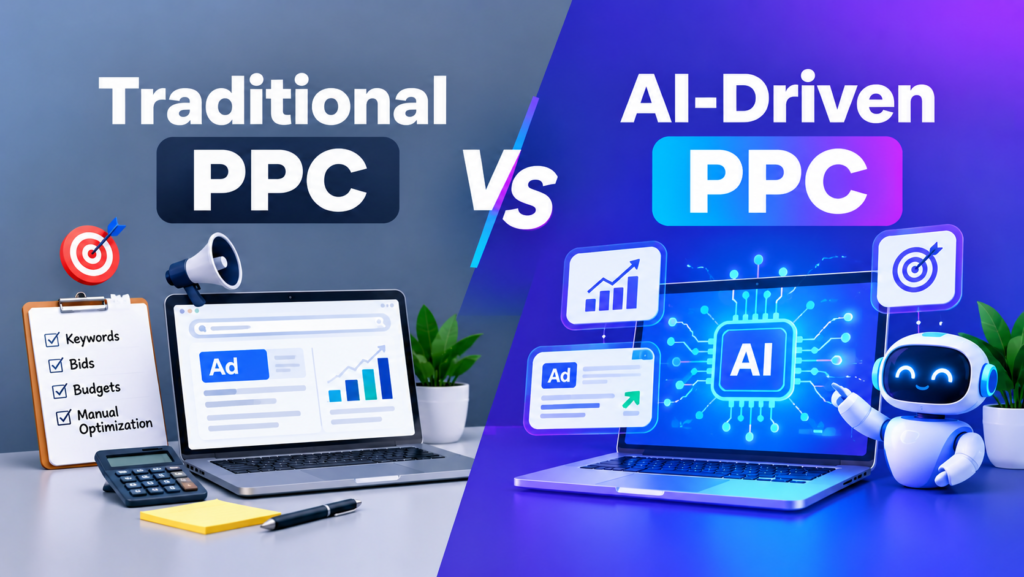
With AI PPC, algorithms can evaluate much larger datasets and make optimization decisions at scale. Google says its Smart Bidding systems can calculate millions of unique bids every second across campaigns, using machine learning to estimate the likelihood of conversion for individual auctions.
How AI Is Used in PPC Campaigns
There are several practical applications of AI in paid advertising. Automated bidding is one of the most established examples. AI can adjust bids according to the probability that a particular search will generate a conversion. Other applications include search-term matching, audience targeting, budget optimization, performance forecasting, and ad-asset creation.
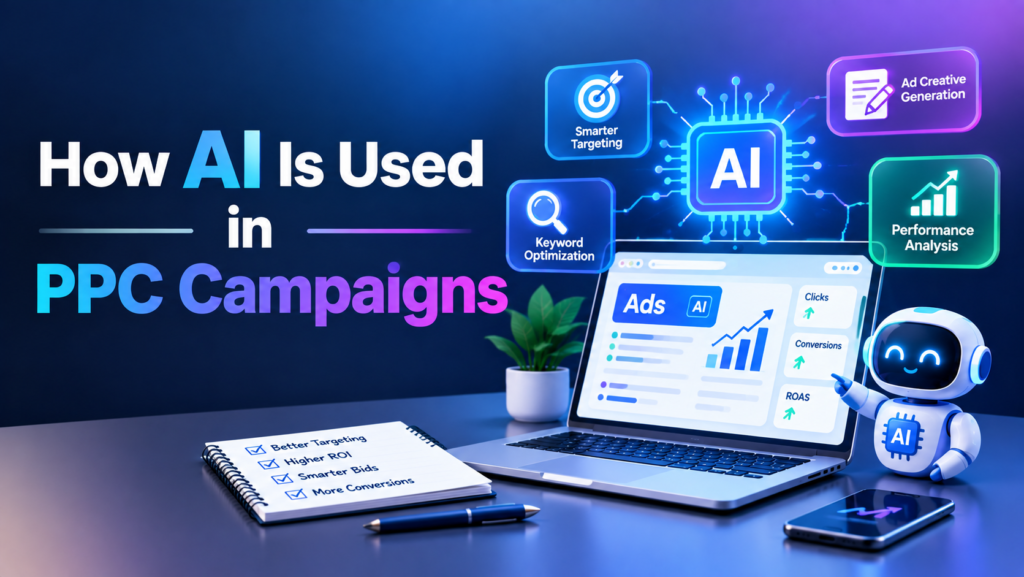
Google’s AI Max for Search campaigns is another current example. It uses AI for search-term matching and asset optimization, helping advertisers expand beyond traditional keyword-based targeting.
Ultimately, AI PPC does not mean removing marketers from the process. Instead, it shifts their role from constantly making small manual adjustments toward setting objectives, providing quality data, developing creative strategy, and monitoring automated decisions. When properly managed, AI PPC advertising can make paid campaigns more responsive while allowing marketers to spend more time on strategy and business growth.
What Is AI-Powered PPC and How Does It Work?
AI-powered PPC is the use of artificial intelligence and machine learning to automate and improve different parts of a pay-per-click advertising campaign. Instead of marketers manually analyzing every keyword, audience, bid, and ad variation, AI can process large amounts of data and make optimization decisions based on patterns and predicted conversion behavior. In 2026, this approach is becoming increasingly important as advertising platforms build AI directly into campaign management.
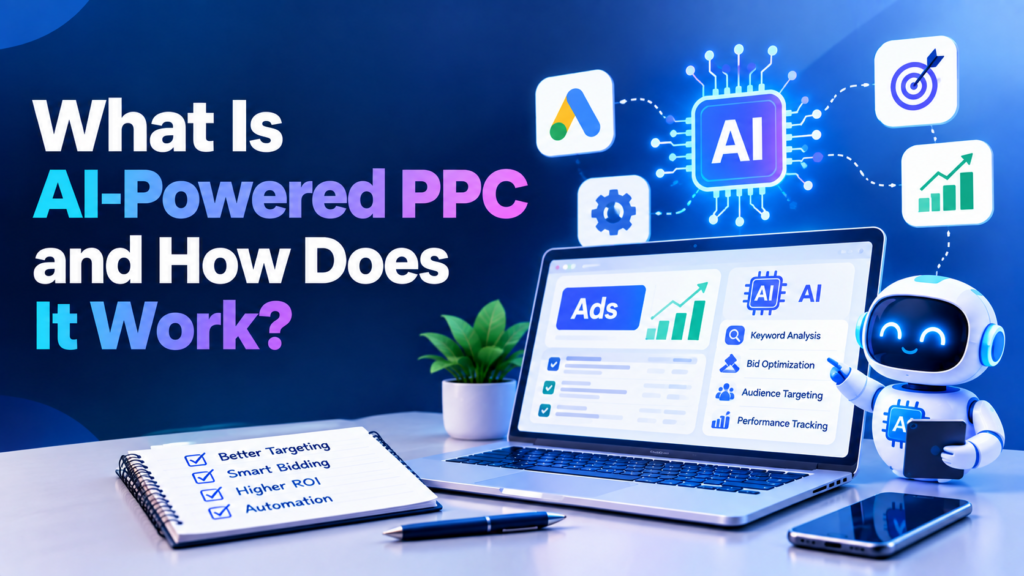
At the core of AI-powered PPC is data. AI systems can analyze search queries, keywords, audience behavior, device type, location, time of day, language, previous interactions, and conversion data to estimate which users and searches are more likely to produce a desired action. Google’s Smart Bidding, for example, uses machine learning and auction-time signals such as device, location, language, browser, operating system, and search context to determine bids.
Automated Bidding and Budget Allocation
One of the most practical uses of AI-powered PPC is automated bidding. Rather than setting a fixed bid for every keyword and manually changing it throughout the day, AI can calculate a bid for each eligible auction based on the likelihood of conversion. Google describes Smart Bidding as “auction-time bidding” because bids are optimized for individual auctions rather than only being adjusted periodically.
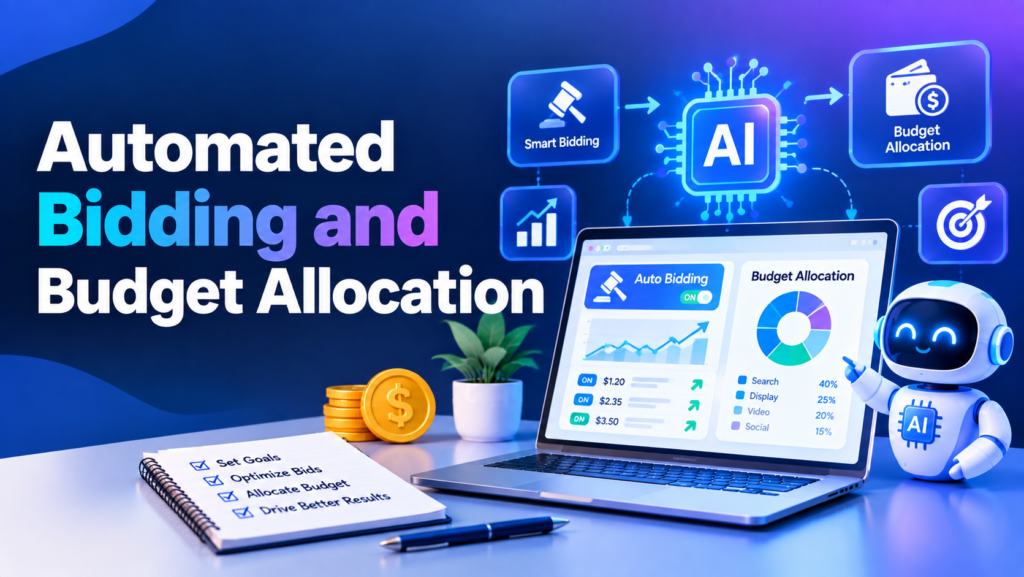
AI can also help advertisers allocate budgets toward campaigns, audiences, and searches that show stronger potential. However, marketers still need to define appropriate budgets, conversion goals, and performance targets.
AI-Assisted Ad Creation and Optimization
AI is also changing how advertising creatives are produced. Google’s AI Max for Search campaigns, for example, includes text customization, which can use existing ads, landing-page content, and other assets to create customized ad copy for relevant searches. It also includes final URL expansion to help direct users to relevant pages.
This means marketers can provide the strategy, brand messaging, offers, and assets while AI helps generate and test variations at scale.
Real-Time Campaign Adjustments
The biggest advantage is responsiveness. Search behavior, competition, and conversion opportunities can change throughout the day. AI can continuously evaluate new signals and update its predictions as campaign data changes. Google states that its bidding algorithms continuously learn and adapt as performance and conversion data evolve.
For digital marketers, AI-powered PPC is therefore less about completely handing over control and more about combining automation with human strategy. Marketers remain responsible for objectives, creative direction, tracking, budgets, and quality control, while AI handles many data-heavy optimization tasks.
How AI PPC Is Transforming Digital Advertising in 2026
In 2026, AI PPC is moving from an optional marketing experiment toward a core part of paid advertising. The shift is visible across the advertising industry: the IAB’s September 2026 outlook raised its U.S. digital ad-spend growth forecast to 12.3% for the year, while its research highlights AI-driven discovery and campaign execution as major changes for advertisers.
More Automated Campaign Management
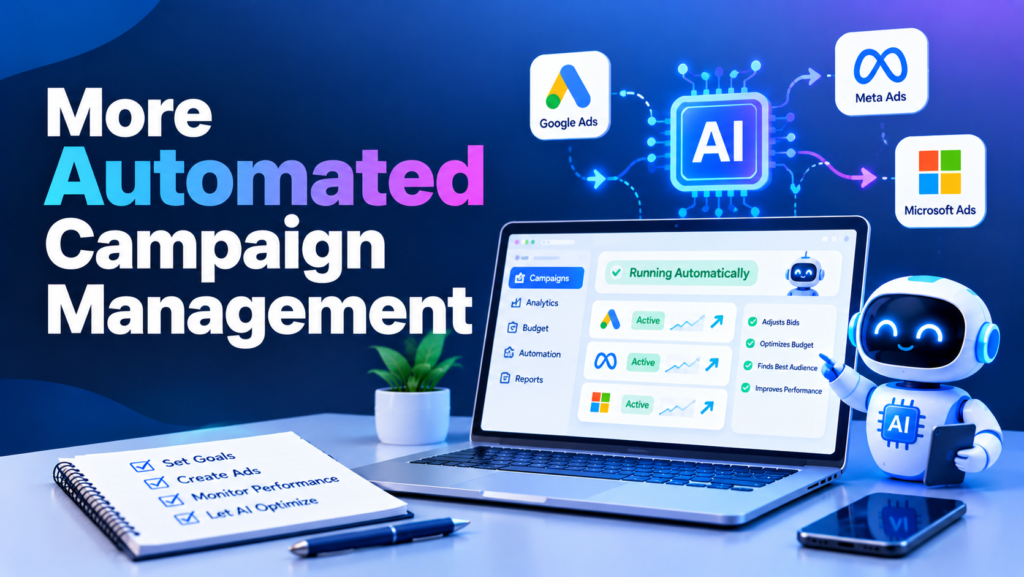
One of the biggest changes brought by AI PPC is automation. Marketers no longer need to manually manage every bid, keyword signal, or audience adjustment. Modern advertising platforms can use machine learning to analyze campaign data and automate many optimization decisions. Google’s Smart Bidding, for example, uses AI to optimize bids for conversions or conversion value at the individual auction level.
This allows marketers to spend less time on repetitive account management and more time on strategy, creative development, and business goals.
Faster Data Analysis and Decision-Making
A PPC campaign can generate thousands of data points from searches, clicks, devices, locations, audiences, and conversions. AI PPC systems can process these signals at a scale that would be difficult to manage manually.
Google says Smart Bidding can consider signals including device, location, time of day, language, operating system, and other contextual information when optimizing bids.
Improved Audience Targeting and Personalization
AI is also making advertising more context-aware. Instead of relying only on predefined audience segments, AI can evaluate behavioral and contextual signals to identify users who are more likely to take a desired action.
This supports more personalized advertising experiences, where different users can potentially receive more relevant messages based on their search intent and context.
Automated Bidding and Budget Optimization
Automated bidding is one of the most established applications of AI PPC. AI can adjust bids for individual auctions according to predicted conversion probability and the advertiser’s selected objective.
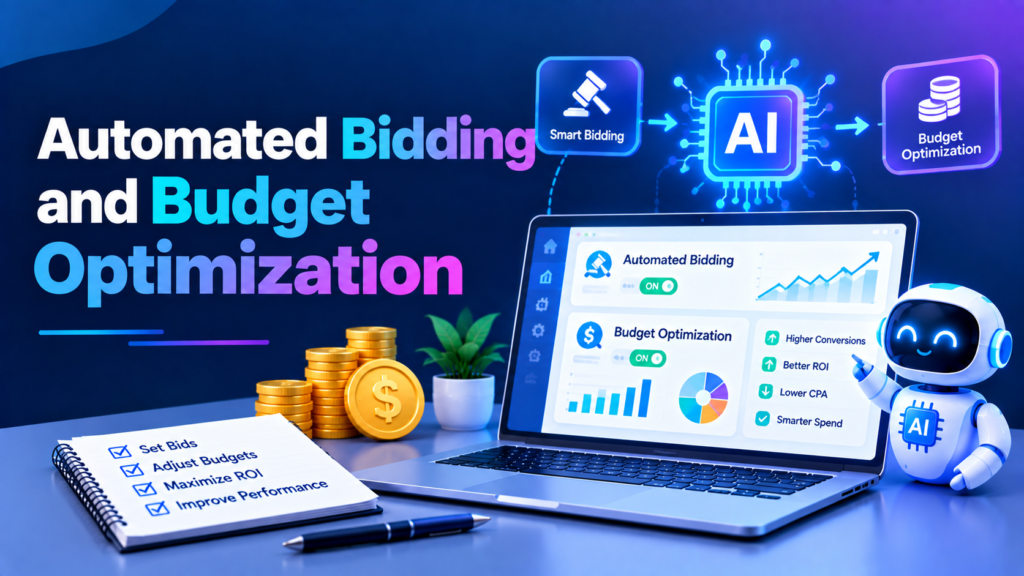
However, automation does not mean marketers should ignore budgets. Accurate conversion tracking and realistic targets remain essential inputs for AI-driven optimization.
AI-Generated Ad Variations
AI is increasingly helping advertisers create and customize ad assets. Google’s AI Max for Search campaigns includes text customization and search-term matching. Google reports that advertisers using the full AI Max feature suite saw an average 7% more conversions or conversion value at similar CPA/ROAS, based on its 2026 internal data for non-retail advertisers.
Better Conversion Tracking and Campaign Insights
Finally, AI PPC is becoming increasingly dependent on high-quality conversion data. AI systems perform better when they receive accurate information about which actions actually matter to a business. Google recommends using meaningful conversion goals and accurate tracking when optimizing campaigns with Smart Bidding.
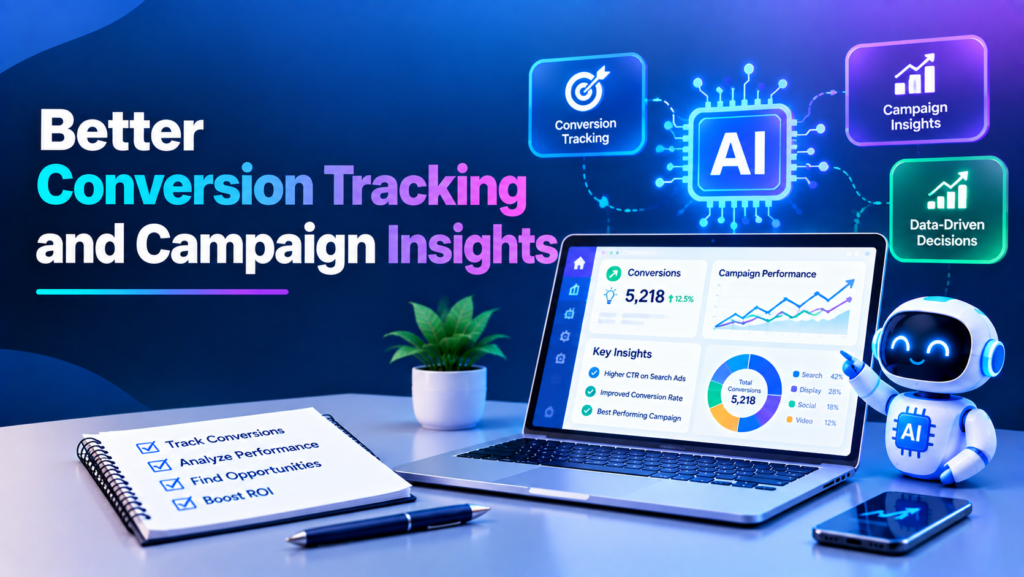
Overall, AI PPC advertising is transforming paid media by combining automation, faster analysis, personalized targeting, creative assistance, and data-driven optimization. The role of the digital marketer is not disappearing—it is shifting toward strategy, oversight, creative thinking, and making sure AI is optimizing for the right business outcomes.
Key Benefits of AI PPC Advertising
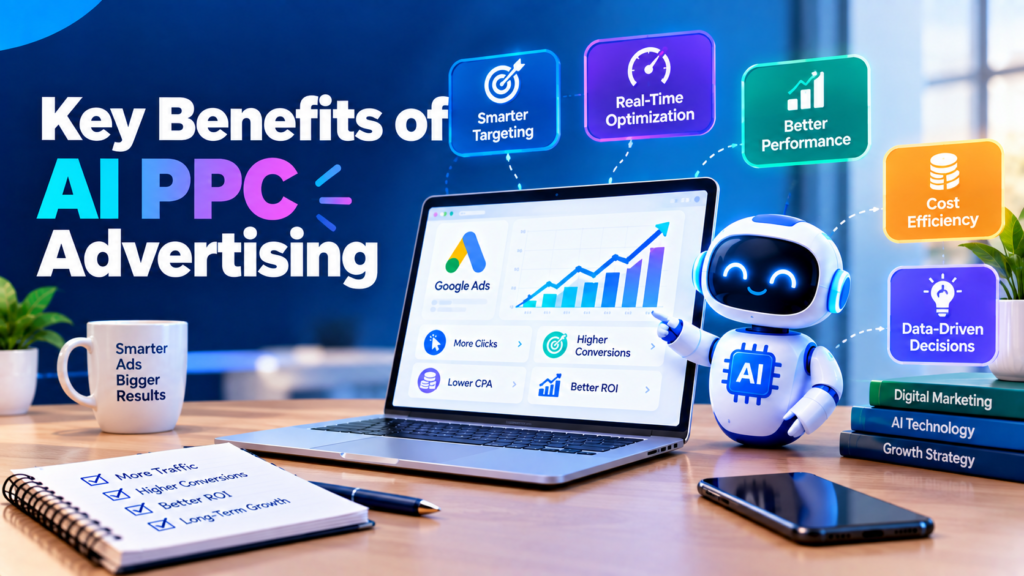
The biggest advantage of AI PPC advertising is that it allows marketers to combine automation with data-driven decision-making. Instead of spending hours making small bid adjustments or manually reviewing every performance signal, AI can process campaign data continuously and help marketers focus on strategy, creative direction, and business outcomes.
Saves Time and Reduces Manual Work
Traditional PPC management can involve repetitive tasks such as adjusting bids, analyzing search terms, reviewing audiences, and testing ad variations. AI PPC reduces much of this manual workload through automated bidding, targeting, and optimization. Google describes Smart Bidding as a way to automate bid optimization at the individual auction level, helping reduce the time required for manual bid management.
Helps Optimize Advertising Budgets
Getting the most from an advertising budget is one of the main goals of PPC. AI PPC advertising can evaluate signals such as device, location, time of day, language, operating system, and search context when determining bids. This allows automated systems to adjust bids according to the predicted likelihood of conversion rather than applying one fixed bid across every situation.
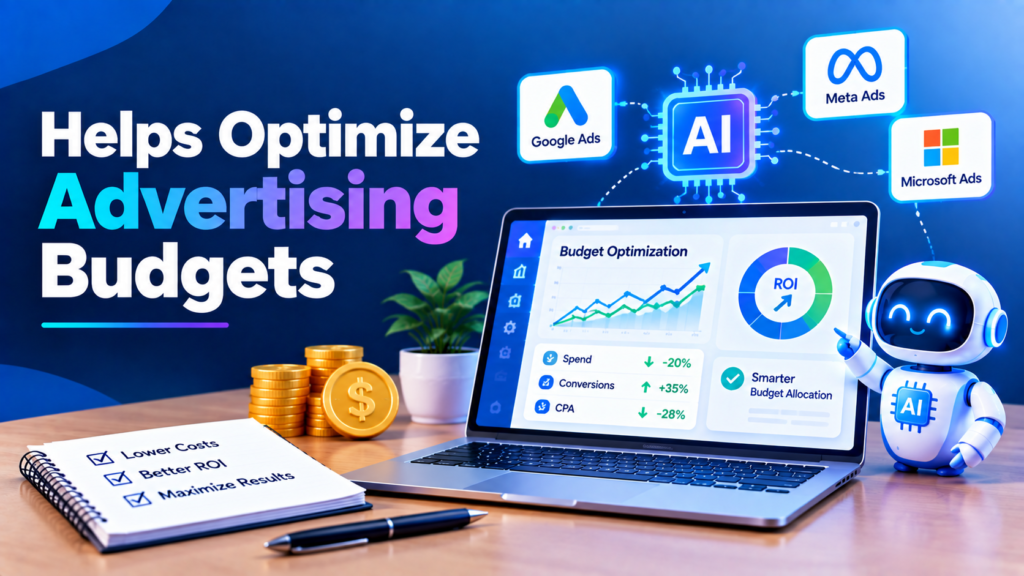
For marketers, this can make budget management more responsive, although accurate conversion tracking and realistic targets remain essential.
Enables Faster Campaign Optimization
AI can analyze campaign information continuously instead of waiting for a marketer to review a weekly or monthly report. Google says Smart Bidding uses machine learning to set millions of unique bids every second across campaigns.
That speed allows AI PPC systems to respond to changing search behavior and performance signals much faster than manual optimization alone.
Supports Personalized Ad Experiences
Different users can have different needs, search intentions, devices, and contexts. AI can evaluate these signals to help advertisers deliver more relevant bids and advertising experiences. Google’s Smart Bidding, for example, considers multiple contextual signals when optimizing individual auctions.
Helps Identify Patterns in Campaign Data
A PPC account can generate a huge amount of information across searches, clicks, conversions, audiences, and devices. Machine learning can identify relationships and patterns across this data that may be difficult to detect manually. This can help marketers understand which types of searches or contexts are associated with stronger conversion performance.
Makes Campaigns Easier to Scale
As businesses expand, manually managing multiple campaigns can become increasingly difficult. AI PPC automation can help advertisers manage bidding and optimization across larger numbers of campaigns and auctions. Google’s AI Max for Search campaigns is one current example of this shift; Google reports that campaigns using its full AI Max feature suite saw an average 7% more conversions or conversion value at similar CPA/ROAS compared with search-term matching alone, based on Google’s 2026 data for non-retail advertisers.
Ultimately, the value of AI PPC advertising is not simply doing more with less human effort. Its bigger role is helping marketers process data faster, automate repetitive decisions, and scale campaigns while humans remain responsible for strategy, brand messaging, and business goals.
AI PPC Strategies Businesses Can Use in 2026
As paid advertising becomes more automated, businesses need a clear strategy for using AI without giving up control of their campaigns. The most effective AI PPC strategies are not about switching everything to automation overnight. They focus on giving AI reliable data, clear conversion goals, and enough flexibility to optimize campaigns while marketers continue to guide the overall strategy.
Use AI for Keyword and Search-Intent Analysis
Modern AI PPC campaigns can move beyond traditional exact-match keyword planning by analyzing the meaning and intent behind searches. Google’s AI Max for Search campaigns uses AI-powered search-term matching to expand beyond existing keywords and identify relevant queries using signals from keywords, creatives, and landing pages.
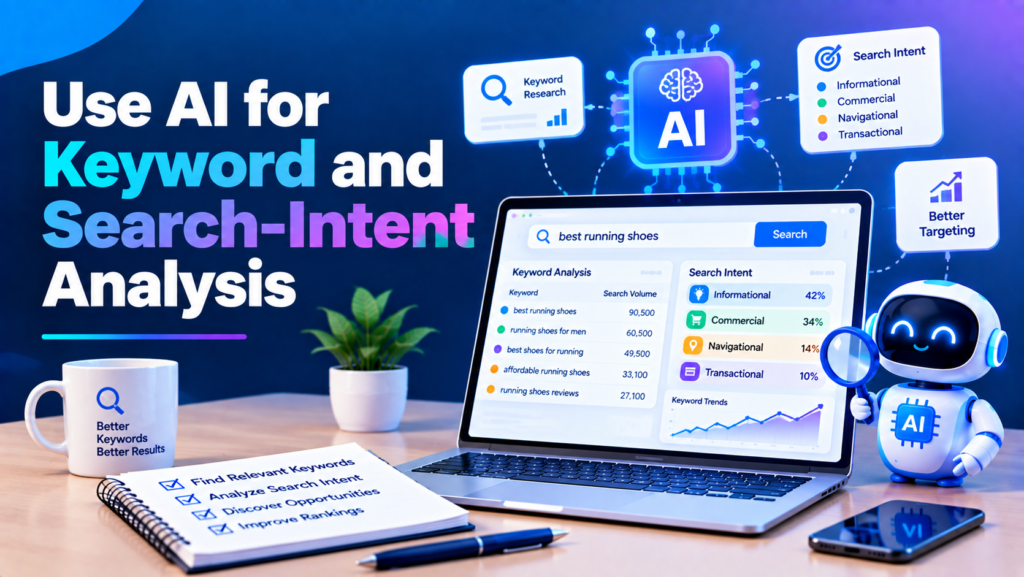
For marketers, this means looking at the problem a customer is trying to solve rather than focusing only on individual keywords. Search-query reports should still be reviewed regularly to identify irrelevant traffic and new opportunities.
Combine AI With Smart Bidding
Smart Bidding is one of the most established AI PPC strategies. Google AI can optimize bids for conversions or conversion value at auction time, using contextual signals such as device, location, time of day, language, and search context. Available strategies include Target CPA, Target ROAS, Maximize Conversions, and Maximize Conversion Value.
The key is to match the bidding strategy with the actual business objective instead of optimizing blindly for clicks.
Test Multiple AI-Generated Ad Variations
AI can also help marketers create more variations of headlines and descriptions for testing. Google’s text customization feature can generate additional assets using information from the advertiser’s website, landing pages, existing ads, and keywords.
A practical strategy is to provide strong brand messaging first and then allow AI to produce variations around different customer needs and search contexts. Human review remains important for accuracy, tone, and brand consistency.
Use First-Party Customer Data
First-party customer data can give AI PPC campaigns stronger information about existing customers and valuable conversion patterns. Google’s Customer Match allows businesses to use their first-party data for advertising across Google properties, subject to its policies and privacy controls.
Businesses should prioritize accurate, permissioned data and use it to improve audience understanding rather than simply collecting more data.
Optimize for Conversions, Not Just Clicks
Clicks can show interest, but conversions are usually closer to the business outcome that matters. Google states that Smart Bidding uses conversion tracking to optimize campaigns toward goals such as conversions or conversion value.
That makes accurate conversion setup essential. Google also notes that conversion actions must be configured appropriately as primary goals to be used for bidding optimization.
Combine Automation With Human Oversight
Automation should support marketing expertise, not replace it. Marketers still need to review search terms, creative quality, landing-page relevance, budgets, conversion signals, and brand controls. Google’s AI Max documentation specifically emphasizes controls for areas such as location and brand settings.
Finally, treat AI PPC strategies as an ongoing testing process. Launch, measure, learn, and refine rather than expecting AI to produce perfect results immediately. The strongest approach combines automation with continuous human analysis, ensuring that AI is working toward meaningful business goals instead of simply generating more traffic.
Best AI PPC Tools for Digital Advertising
Choosing the right tools can make a major difference when managing paid campaigns, especially as AI becomes more deeply integrated into advertising platforms. Today, AI PPC tools can support everything from keyword research and ad creation to campaign analysis, audience targeting, and optimization. The important point is that different tools solve different problems, so marketers should choose them according to their campaign goals rather than simply choosing the tool with the most AI features.
Google Ads AI Features
Google Ads is at the center of the AI PPC shift. Its AI-powered features include Smart Bidding, responsive ad assets, Performance Max, and AI Max for Search campaigns. Smart Bidding uses machine learning to optimize bids based on conversion goals and auction-time signals, while AI Max adds AI-powered search-term matching and text customization. Google reports that advertisers using the full AI Max feature suite achieved an average 7% increase in conversions or conversion value at similar CPA or ROAS, based on its 2026 internal data for non-retail advertisers.
AI-Powered Keyword Research Tools
Keyword research is also becoming more data-driven. Tools such as Semrush can help advertisers research paid keywords, analyze competitors, and identify opportunities before launching campaigns. Its Advertising Toolkit combines competitor research, keyword planning, ad creation, and campaign tracking, with AI-assisted ad generation available for campaign assets.
AI Ad-Copy Generation Tools
AI can help marketers produce multiple headline and description variations much faster. This is useful when testing different customer benefits, offers, and messaging angles. Google provides AI-assisted text customization, while newer AI advertising environments are also encouraging advertisers to create multiple, diverse variations rather than relying on one message.
AI Campaign Analytics and Reporting Tools
For larger accounts, analytics and automation tools can reduce the time spent searching for performance issues. Optmyzr’s Sidekick, for example, can analyze PPC performance, summarize reports, identify trends, and provide optimization recommendations. Its PPC Investigator can help identify whether changes in clicks, conversions, or costs are linked to campaigns, keywords, placements, devices, or other account elements.
AI Audience, Targeting, and Creative Optimization
AI can also help advertisers make better use of audience and contextual signals, while creative tools can generate and test different ad variations. This makes AI PPC advertising particularly useful for campaigns that need to operate across many audiences, products, or locations.
How to Choose AI PPC Tools
Before selecting AI PPC tools, check whether they integrate with your advertising platforms, provide reliable reporting, offer appropriate automation controls, protect customer data, and allow human review before major changes are applied. For example, Optmyzr allows AI-generated recommendations and changes to be reviewed before they are applied, providing marketers with an additional control layer.
The best approach is not to replace marketers with AI, but to combine the speed of AI PPC technology with human judgment, creative thinking, and a clear performance strategy.
AI PPC vs Traditional PPC
The difference between traditional PPC and AI PPC is mainly about how much of the campaign management process depends on automation and machine learning. Traditional PPC gives marketers more direct control over individual decisions, while AI-powered systems can analyze large amounts of data and automate many decisions based on conversion goals and real-time signals.
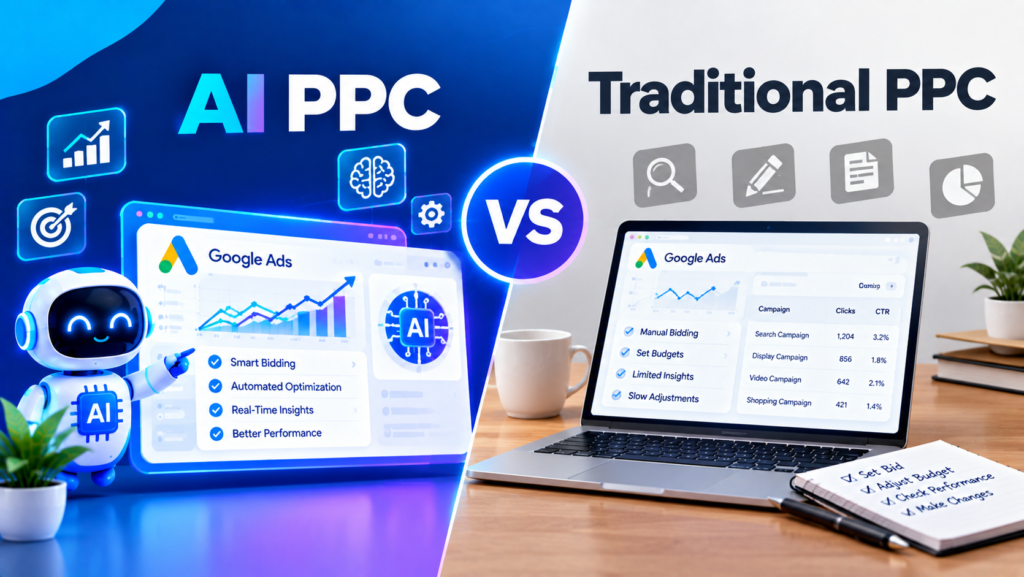
This does not mean that traditional PPC has become irrelevant. Manual controls are still useful for keyword research, campaign structure, brand protection, creative strategy, and performance analysis. The major change in 2026 is that advertising platforms can now handle more of the repetitive optimization work.
| Factor | Traditional PPC | AI-Powered PPC |
| Bidding | Mostly manual or rule-based | AI-assisted and automated |
| Data analysis | Marketer reviews and interprets data | AI processes large datasets and identifies patterns |
| Ad testing | Marketers create and test variations manually | AI can generate and customize additional variations |
| Targeting | Audience and keyword setup is largely manual | Data-driven and automated optimization |
| Optimization | Usually performed periodically | More continuous and signal-driven |
| Scalability | Requires more manual management | Greater automation across campaigns |
Bidding
In traditional PPC, marketers may set individual keyword bids or create rules for changing them. With AI PPC, platforms such as Google Ads can use machine learning to optimize bids for conversions or conversion value at the time of each auction. Google’s Smart Bidding uses contextual signals such as device, location, time of day, language, browser, and other factors when making bidding decisions.
Data Analysis
Traditional PPC analysis often requires marketers to review reports and identify trends themselves. AI systems can process much larger datasets and recognize patterns across searches, audiences, devices, and conversions. Google says its Smart Bidding systems can set millions of unique bids every second across campaigns.
Ad Testing
Another major difference is creative testing. Traditional campaigns depend heavily on marketers manually writing and testing ad variations. AI-powered PPC can assist with this process. Google’s AI Max text customization can generate additional headlines and descriptions using information from landing pages, existing ads, keywords, and other campaign context.
Targeting and Optimization
Traditional PPC generally relies more heavily on manually defined keywords and targeting settings. AI-powered systems can expand search-term matching and adjust targeting using additional signals. For example, AI Max uses search-term matching and other AI features to find relevant queries that may not have been covered by the advertiser’s original keyword setup.
Scalability
For a small campaign, manual management may be manageable. But as a business adds products, locations, audiences, and campaigns, maintaining everything manually becomes increasingly difficult. AI PPC advertising can automate many repetitive tasks, making it easier to manage campaigns at a larger scale.
Ultimately, AI PPC and traditional PPC should not be viewed as completely separate approaches. In 2026, many successful campaigns combine automated technology with human oversight. AI handles data-heavy optimization, while marketers remain responsible for business goals, messaging, strategy, budget decisions, and quality control.
Challenges and Limitations of AI PPC
Although AI PPC can automate many time-consuming advertising tasks, it is not a set-and-forget solution. AI systems depend heavily on the quality of the data, goals, signals, and instructions they receive. For businesses adopting AI-powered advertising in 2026, understanding its limitations is just as important as understanding its benefits.
Over-Reliance on Automation
One of the biggest risks of AI PPC advertising is relying too heavily on automated recommendations. AI can adjust bids, find search opportunities, and optimize campaigns, but it does not automatically understand every business priority. A campaign might generate conversions while still attracting low-value customers or promoting an offer that is no longer relevant.
Automation should therefore support a marketing strategy rather than replace it.
Limited Control Over Automated Decisions
Traditional PPC often gives marketers more direct control over individual bids, keywords, and targeting settings. With AI-driven campaigns, some optimization decisions are made by algorithms based on signals that can be difficult to inspect at the individual-auction level. Google notes that automated bidding uses many contextual signals to determine bids, rather than applying one fixed bid manually to every search. (support.google.com)
This can improve efficiency, but marketers need to understand which controls remain available and monitor campaigns regularly.
Poor Results From Inaccurate Conversion Data
AI learns from the conversion information provided to it. If tracking is incomplete, duplicated, delayed, or optimized around the wrong conversion action, the system can make decisions based on misleading signals. Google specifically emphasizes accurate conversion tracking when using Smart Bidding because conversion data informs automated optimization. (support.google.com)
For example, optimizing only for form submissions may look successful on a dashboard while producing few qualified leads for the sales team.
Privacy and Data Considerations
AI-powered advertising can make extensive use of audience and contextual signals, which makes responsible data handling increasingly important. Businesses need to follow applicable privacy laws, advertising-platform policies, and their own consent requirements when using customer information for targeting or measurement.
Google’s Customer Match documentation, for instance, requires advertisers to follow its customer data policies when using first-party information for advertising. (support.google.com)
Human Strategy and Oversight Are Still Essential
A strong AI PPC campaign still needs a human marketer behind it. People need to define the business objective, choose appropriate conversion goals, develop the offer, understand the target customer, review performance, and decide when an automated recommendation makes sense.
AI is excellent at processing data and recognizing patterns, but business context still matters.
AI-Generated Content Requires Review
AI can produce headlines, descriptions, images, and other advertising assets quickly, but generated content can contain inaccurate claims, awkward wording, or messaging that does not match a brand’s voice. Google provides tools that can generate or customize ad assets, but advertisers remain responsible for the content used in their campaigns. (support.google.com)
For that reason, every AI-generated asset should be reviewed for accuracy, brand consistency, compliance, and relevance before it becomes part of a live campaign.
Overall, AI PPC works best as a partnership between technology and human expertise. Automation can handle large amounts of repetitive data-driven work, but marketers still need to provide the strategy, quality control, and judgment that turn advertising automation into meaningful business results.
How to Build an AI-Powered PPC Campaign
Building an effective AI PPC campaign in 2026 is not simply about switching on every available automation feature. The real process starts with a clear business objective, accurate data, relevant creative, and continuous monitoring. AI can handle many data-heavy tasks, but marketers still need to guide the campaign and make strategic decisions.
1. Define Your Campaign Objectives
Start by deciding what the campaign needs to achieve. Your objective could be generating leads, increasing online sales, driving calls, or improving conversion value. A clear goal gives AI a specific outcome to optimize toward.
2. Set Up Accurate Conversion Tracking
Conversion tracking should be in place before relying heavily on automation. Google explains that conversion-based Smart Bidding uses conversion data to optimize bids for actions that matter to the business. Without reliable tracking, automated systems may optimize toward incomplete or misleading signals.
Track meaningful actions such as purchases, qualified lead submissions, phone calls, or registrations rather than focusing only on clicks.
3. Research Keywords and Search Intent
Keyword research remains important even in automated campaigns. Analyze what potential customers are searching for and identify the intent behind those searches. Google’s AI Max for Search campaigns can expand beyond existing keywords using AI-powered search-term matching and signals from keywords, creatives, and website URLs.
4. Define Your Audiences
Identify your ideal customers based on factors such as location, interests, previous interactions, and customer value. The more relevant your audience signals and conversion information are, the better your AI PPC campaign can align with your marketing objectives.
5. Create Strong Ad Assets
Develop clear headlines, descriptions, images, videos, and landing-page experiences that match customer needs. AI can help generate or customize variations, but marketers should review every asset for accuracy, brand voice, and relevance.
6. Select Appropriate Automation Features
Choose automation based on your campaign objective rather than using every feature available. Google Smart Bidding uses AI to optimize bids for conversions or conversion value at auction time, while AI Max provides additional search-term matching and asset optimization capabilities.
7. Set Budgets and Bidding Strategies
Set a realistic daily or campaign budget and select a bidding strategy that matches your objective. Options such as Maximize Conversions, Target CPA, Maximize Conversion Value, and Target ROAS are designed for different performance goals.
8. Launch, Monitor, Test, and Optimize
Once the campaign is live, don’t treat automation as a “set and forget” system. Review conversions, cost per conversion, search terms, audience performance, creative results, and landing-page behavior. Google introduced additional AI Max testing and planning capabilities in August 2026, including A/B testing for budgets and ROI targets across Search campaigns.
The most effective AI PPC approach is a continuous cycle: launch, measure, learn, test, and refine. AI provides speed and automation, while human marketers provide the strategy and judgment needed to keep campaigns focused on meaningful business results.
The Future of AI PPC Advertising
The future of AI PPC advertising is moving toward greater automation, smarter decision-making, and more personalized customer experiences. In 2026, AI is no longer being used only for analyzing campaign reports or generating ad copy. Major advertising platforms are building AI directly into campaign targeting, bidding, creative development, measurement, and optimization. Google, for example, describes AI Max for Search as a broader AI-powered approach that combines search-term matching, text customization, and landing-page expansion.
Increasing Campaign Automation
Campaign management is likely to become increasingly automated. AI can already optimize bids at auction time, identify search opportunities, and assist with campaign recommendations. Google also introduced new agentic capabilities in Google Ads and Analytics in August 2026 to help marketers uncover insights and take actions more efficiently.
For marketers, this means less time spent on repetitive account-management tasks and more time focused on strategy, creative ideas, offers, and customer experience.
More AI-Assisted Creative Development
Creative production is becoming another major area of change. Google reported that advertisers created nearly 70 million Gemini-generated creative assets in Q4 2025 alone, while the number of Gemini-generated assets increased threefold during 2025.
As these tools improve, AI PPC advertising campaigns will be able to generate, customize, and test more creative variations. Human marketers will still need to provide the brand voice and review outputs for accuracy and relevance.
Greater Use of Predictive Analytics
The next generation of AI PPC will rely increasingly on predictive analytics. Instead of simply reporting what happened yesterday, AI systems can use historical and real-time signals to estimate which searches, audiences, and campaign conditions are more likely to produce conversions.
This can help advertisers make faster decisions about bids, audiences, budgets, and creative performance.
More Personalized Advertising
As search becomes more conversational and user behavior becomes more complex, advertising is also becoming more personalized. Google says consumers increasingly use AI experiences to research and evaluate products, while its 2026 Search initiatives are designed to make ads more helpful within conversational search experiences.
For businesses, this creates an opportunity to deliver messages that are more closely aligned with individual search intent and customer needs.
Quality Data Will Become Even More Important
Better automation does not mean data matters less. It means data quality matters more. Conversion tracking, first-party customer information, accurate campaign goals, and clean measurement give AI better signals from which to learn.
This is especially important as advertisers move from optimizing for simple clicks toward business outcomes such as qualified leads, sales, and conversion value. The IAB’s September 2026 outlook also identifies AI-driven discovery and measurement as important priorities for advertisers.
Marketers Will Still Drive Strategy
Despite increasing automation, marketers are unlikely to disappear from the PPC process. Their role is evolving. Instead of manually controlling every campaign setting, marketers will increasingly focus on strategy, positioning, creative direction, customer insights, data quality, and deciding how automation should be used.
In the years ahead, AI PPC is likely to become less about “AI versus marketers” and more about marketers using AI as a performance and productivity partner. Businesses that combine automation with strong strategy, reliable data, and human oversight will be better positioned to adapt as paid advertising continues to evolve.
Frequently Asked Questions About AI PPC Advertising
What is AI PPC advertising?
AI PPC advertising is the use of artificial intelligence and machine learning to automate and optimize pay-per-click advertising activities. AI can help with bidding, targeting, search-term matching, ad asset creation, and campaign analysis. Google’s Smart Bidding, for example, uses Google AI to optimize bids for conversions or conversion value in every auction.
How does AI-powered PPC work?
AI-powered PPC works by analyzing campaign signals such as search context, device, location, language, time of day, audience information, and conversion data. It then uses machine-learning predictions to determine which opportunities are more likely to achieve the advertiser’s goal. Google says Smart Bidding can calculate millions of unique bids every second across campaigns.
What are the best AI PPC strategies for 2026?
Effective AI PPC strategies include using accurate conversion tracking, matching automation with the correct business goal, testing different ad assets, analyzing search intent, and combining AI automation with human oversight. Businesses should focus on meaningful outcomes such as qualified leads, sales, or conversion value rather than optimizing only for clicks.
Which AI PPC tools can businesses use?
Businesses can use Google Ads AI features such as Smart Bidding and AI Max for Search campaigns. AI Max provides features including search-term matching, text customization, and Final URL expansion. Other categories include AI-powered keyword research, ad-copy generation, campaign analytics, audience insights, and creative optimization tools.
Is AI better than traditional PPC?
There is no universal answer because performance depends on the campaign, data quality, business objective, and implementation. AI can automate large amounts of data-heavy work and react to signals faster, while traditional PPC can provide more direct manual control. Many modern campaigns combine automation with human planning and monitoring.
Can AI manage a PPC campaign automatically?
Yes. AI can automate important areas such as bidding, search-term matching, and some creative optimization. For example, Google Smart Bidding automatically adjusts bids at auction time, while AI Max can continuously refine targeting and creative delivery using real-time signals.
However, businesses still need to set objectives, budgets, conversion goals, brand controls, and other campaign parameters.
How can AI improve Google Ads performance?
AI can improve campaign management by analyzing more signals, optimizing bids, expanding relevant search coverage, and assisting with ad customization. Google says AI Max is designed to help Search campaigns process real-time signals and improve targeting and creative relevance.
Actual results vary by account, industry, conversion volume, data quality, and campaign setup, so AI should be evaluated using business-relevant performance metrics.
Will AI replace PPC marketers?
AI is more likely to change the role of PPC marketers than eliminate it completely. Automation can handle many repetitive and data-intensive tasks, but marketers are still needed to define strategy, understand customers, develop offers and messaging, review creative, manage budgets, and interpret business results.
The future of AI PPC advertising is therefore likely to be a collaboration between technology and human expertise. The tools can process data and automate decisions, while marketers provide the context and direction needed to turn advertising activity into sustainable business growth.
Conclusion
AI PPC advertising is changing paid advertising in 2026 by moving many campaign-management tasks from manual processes toward intelligent automation. From automated bidding and search-term matching to AI-assisted creative development and campaign insights, advertising platforms can now process large amounts of data and respond to changing signals much faster than traditional workflows. Google’s current advertising products reflect this shift, with Smart Bidding using Google AI to optimize for conversions or conversion value at auction time and AI Max expanding Search campaigns with AI-powered targeting and creative features.
The growth of AI-powered PPC does not simply mean giving an advertising account complete control to AI. Instead, it changes how marketers manage campaigns. AI can handle repetitive, data-intensive tasks, while marketers can spend more time understanding customers, developing offers, creating stronger messaging, and making strategic decisions. Google has also introduced new AI and agentic capabilities across Ads and Analytics to help marketers find insights faster while keeping them involved in decision-making.
For businesses, the right AI PPC strategies include accurate conversion tracking, meaningful campaign objectives, search-intent analysis, smart bidding, creative testing, and continuous performance monitoring. The quality of the data provided to AI remains critical because automated systems learn from the signals and conversion information available to them. Google’s recent updates to bidding, budgeting, and campaign testing show that PPC is becoming increasingly focused on automated, data-driven optimization.
At the same time, AI PPC tools are expanding beyond basic bid automation. Marketers can now use AI for keyword and search-term analysis, ad customization, audience discovery, reporting, testing, and forecasting. Google has reported that advertisers using the full AI Max feature suite saw an average 7% more conversions or conversion value at a similar CPA/ROAS, based on its 2026 internal data for non-retail advertisers. This is Google’s own reported result, so individual campaign performance can vary.
Looking ahead, AI is likely to become an even larger part of digital advertising as search becomes more conversational, customer journeys become more complex, and advertising platforms automate more decisions. The future of PPC will not simply be about machines replacing marketers. It will be about marketers using AI more intelligently—combining automation, reliable data, creative thinking, and human strategy to build campaigns that are more relevant, measurable, and adaptable.