
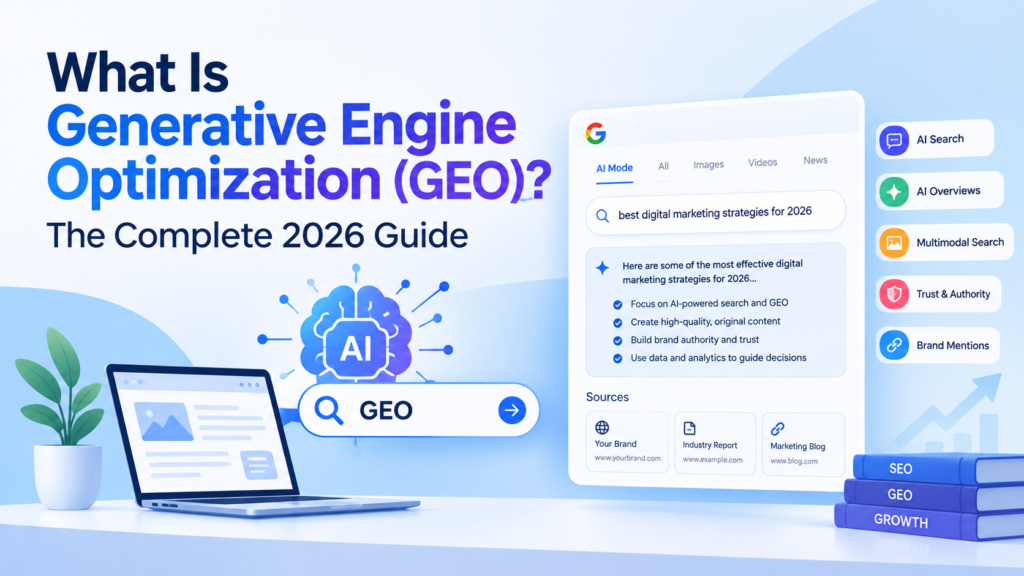
Search is changing faster than it has in years. People are no longer relying only on traditional Google results to find information, products, services, or brands. They are increasingly asking AI-powered platforms such as ChatGPT, Google AI Overviews, Google AI Mode, and Gemini to research topics and provide direct answers. This shift has created a new opportunity for marketers: Generative Engine Optimization (GEO).
What Is Generative Engine Optimization (GEO)?
Generative Engine Optimization (GEO) is the practice of improving a brand’s online presence so that it has a better chance of being discovered, mentioned, cited, and accurately represented in AI-generated answers. Instead of focusing only on getting a webpage into Google’s traditional blue-link results, GEO considers how AI-powered search experiences understand and present information.
For marketers, the goal is simple: make your business a useful and credible source when potential customers ask AI tools questions related to your industry.
GEO is closely connected with SEO because both depend on useful content, relevance, authority, and a strong online presence. However, the search experience is different. Traditional SEO generally focuses on earning rankings and clicks, while Generative Engine Optimization (GEO) also considers visibility inside AI-generated responses.
Why AI-Powered Search Is Changing How People Discover Information
The scale of AI-powered search makes this shift difficult for businesses to ignore. Google reported in June 2026 that AI Overviews had more than 2.5 billion monthly active users, while AI Mode had surpassed 1 billion monthly users. Google also reported that AI Mode queries had more than doubled every quarter since its launch.
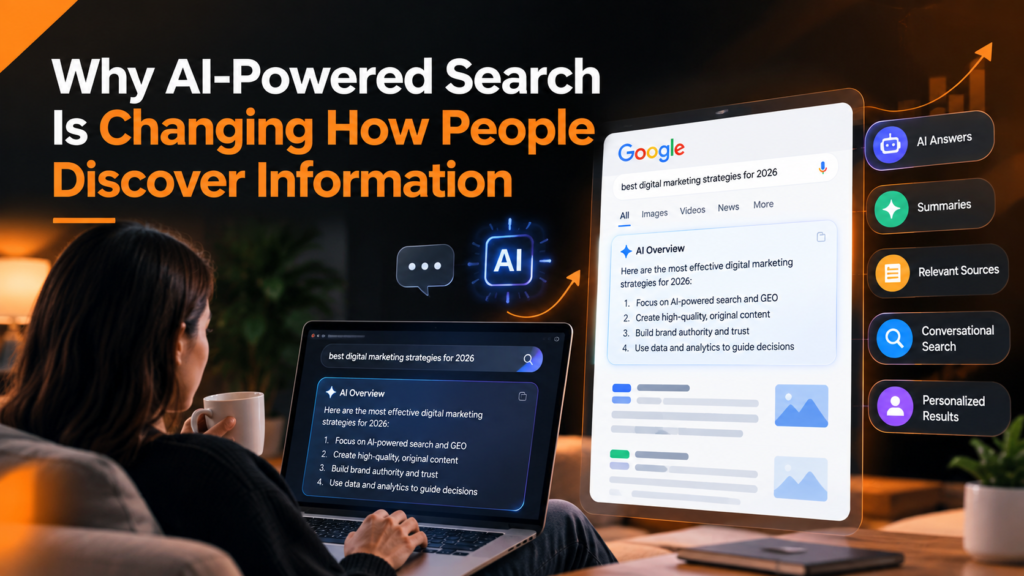
This means users are asking longer, more conversational, and more complex questions. Instead of searching for “best digital marketing agency,” someone might ask an AI assistant, “What should a small business look for when choosing a digital marketing agency in India?”
That change matters because AI systems can combine information from multiple sources before generating an answer.
How GEO Differs From Traditional SEO
Traditional SEO primarily aims to improve visibility in search engine results pages and attract website traffic. GEO expands that objective to include visibility within AI-generated answers, brand mentions, and citations.
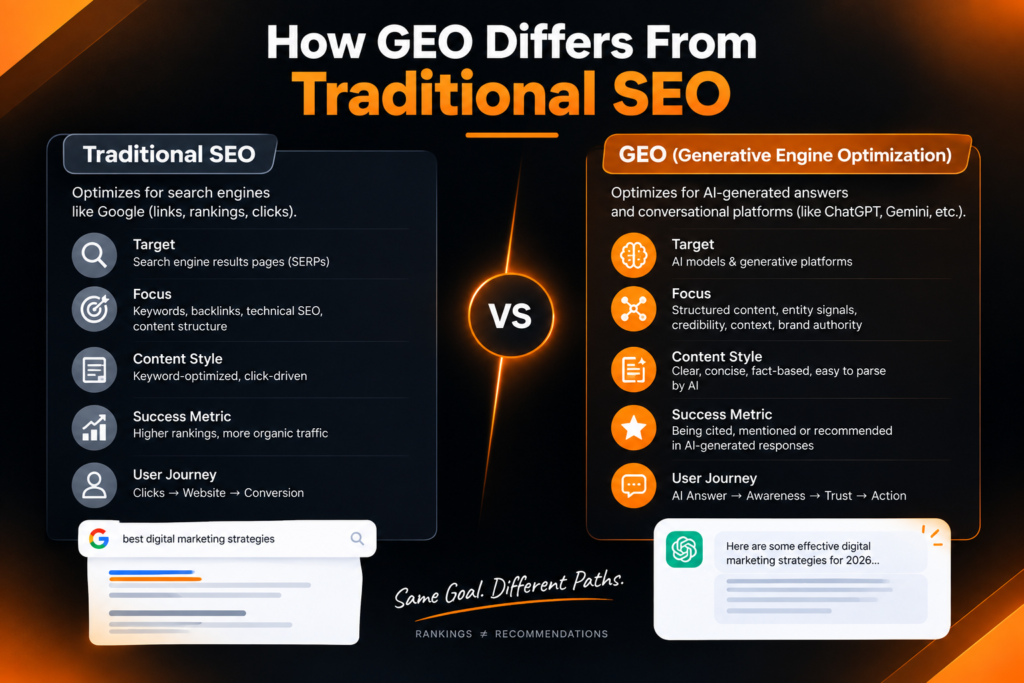
Think of SEO as getting your business onto the search results page. GEO optimization is about making your brand relevant enough to become part of the answer itself.
Why Businesses Need AI Search Visibility in 2026
For businesses, Generative Engine Optimization (GEO) is becoming another layer of search visibility. A strong GEO optimization strategy can complement SEO by making content easier for both search engines and AI systems to understand.
As AI-powered search continues to evolve, businesses that consistently publish accurate, useful, well-structured content can create more opportunities to be discovered across the changing search journey. Generative Engine Optimization 2026 is therefore not about abandoning SEO—it is about expanding the definition of online visibility.
What Is Generative Engine Optimization (GEO)?
Generative Engine Optimization (GEO) is the process of optimizing a brand’s online content so AI-powered search systems can better understand, use, and potentially cite that information when generating answers. Unlike traditional search, where users typically receive a list of webpages, generative search can synthesize information from multiple sources and provide a conversational response.
In simple terms, Generative Engine Optimization (GEO) helps businesses move from simply ranking for a keyword to becoming a useful source of information within AI-generated answers. This makes GEO increasingly relevant for brands that want to improve their visibility across the changing search landscape.
How Do Generative Search Engines Find and Understand Information?
AI-powered search systems analyze information from websites and other sources to understand the context behind a user’s question. Modern search experiences can also break complex questions into related subtopics and search for information across multiple areas before generating a response.
For example, Google says its AI Mode uses a “query fan-out” approach, breaking a user’s question into multiple searches to explore relevant information more deeply.
This is why GEO optimization should focus on more than repeating keywords. Clear explanations, logical content structure, relevant context, trustworthy information, and strong topical coverage can make content easier for search systems to interpret.
How Are AI-Generated Answers Different From Traditional Search Results?
Traditional search generally presents users with a list of webpages, allowing them to choose which result to open. Generative search can instead provide a synthesized response and then offer supporting links for users who want to explore the original sources.
Google’s AI Mode, for example, supports longer and more complex questions, follow-up conversations, and links to relevant web content. Google reported in 2026 that the average AI Mode search was three times longer than a traditional Search query in its U.S. research.
This changes the opportunity for marketers. With Generative Engine Optimization (GEO), the objective isn’t simply to attract a click from a conventional results page. It is also to create content that can contribute useful information to an AI-generated response.
Examples of AI-Powered Search Platforms
Several platforms now provide AI-powered search or answer experiences, including:
- Google AI Overviews and AI Mode
- ChatGPT
- Google Gemini
- Microsoft Copilot
- Perplexity
How Does Generative Engine Optimization Work?
Generative Engine Optimization (GEO) works by making your website and content easier for AI-powered search systems to discover, understand, evaluate, and potentially reference in generated answers. Unlike traditional SEO, where the primary goal is often to rank a webpage for a specific query, GEO optimization focuses on the broader context surrounding a topic, including relevance, credibility, structure, and supporting information.
How AI Systems Discover Website Content
AI-powered search systems can discover information through web crawling, search indexes, and other information sources. For example, OpenAI states that websites can appear in ChatGPT Search and recommends allowing OAI-SearchBot to crawl content that publishers want discovered and cited.
Google’s AI Mode uses a technique called query fan-out, where a complex question can be broken into multiple related searches across different subtopics. The system then brings information from those searches together to create a response.
For marketers, this means content should not exist only to target one keyword. It should comprehensively answer the questions users are likely to ask around a subject.
How Relevance and Context Influence AI Responses
AI systems need to understand not only individual words but also the meaning and context behind a query. A well-structured article that clearly explains a topic, answers related questions, and uses relevant terminology gives search systems more useful context.
For example, an article about GEO marketing should explain what GEO marketing means, how it works, who benefits from it, and how it relates to SEO. This creates a stronger topical connection than repeatedly inserting the phrase “GEO marketing” throughout a page.
This is where Generative Engine Optimization (GEO) becomes particularly useful: the focus shifts from keyword repetition toward comprehensive, understandable, and genuinely helpful content.
The Role of Authority, Credibility, and Facts
Credibility matters because AI-generated answers can combine information from multiple sources. OpenAI notes that ChatGPT Search uses multiple factors intended to identify relevant and reliable results, although placement is not guaranteed.
Therefore, businesses should support important claims with credible sources, use accurate statistics, demonstrate subject expertise, and regularly update outdated information. Original research, first-hand experience, expert insights, and authoritative references can also strengthen the overall quality of a page.
How AI Systems May Select Sources
There is no single publicly documented formula that guarantees a website will be selected in an AI-generated answer. However, current AI search experiences emphasize relevance and useful source material. Google has also introduced features designed to help users discover original content and trusted sources within AI Search.
For a digital marketer, the practical takeaway is straightforward: create content that directly answers real questions, covers a topic thoroughly, uses trustworthy information, and makes important facts easy to understand.
That is the foundation of GEO optimization and an important part of a broader Generative Engine Optimization 2026 strategy.
Why Is Generative Engine Optimization Important in 2026?
Search behavior is moving beyond short keyword-based queries. Users are increasingly asking AI-powered search tools complete questions, requesting comparisons, recommendations, explanations, and follow-up answers. For businesses, this means visibility is no longer limited to appearing among traditional search results. Your content may also need to be useful enough to be surfaced, referenced, or cited within AI-generated responses.
Changes in Online Search Behavior
One of the clearest changes is the growth of longer and more conversational searches. Google reported in May 2026 that the average AI Mode query was three times longer than a traditional Google Search query. Google also found that more than one in six U.S. AI Mode searches were using voice or images, showing how search is becoming increasingly conversational and multimodal.
For marketers, this changes how content should be planned. Instead of creating an article around a single keyword, businesses need to understand the questions, problems, comparisons, and follow-up queries surrounding their topic.
Growth of AI-Powered Search
The scale of AI-powered search in 2026 makes this more than a passing trend. Google reported that AI Overviews now have more than 2.5 billion monthly active users, while AI Mode has surpassed 1 billion monthly users globally. Google also says AI Mode queries have more than doubled every quarter since its launch.
This growing usage creates new opportunities for brands and publishers to be discovered through AI-assisted search experiences. It also means marketers need to understand how their content performs beyond conventional search rankings.
Why Traditional Rankings Aren’t the Only Visibility Opportunity
Traditional SEO remains important, but a search result ranking is not the only way a customer can encounter your brand. AI-powered search can summarize information and provide links to supporting websites, meaning a business can potentially gain visibility by contributing useful information to an AI-generated answer.
Google says its AI Search experiences continue to connect users with websites and, in 2026, introduced additional features focused on helping people discover original content and trusted sources.
This is where Generative Engine Optimization (GEO) becomes relevant. The objective is not simply to repeat keywords; it is to build content that is clear, comprehensive, credible, and genuinely useful.
How Businesses Can Prepare for Generative Engine Optimization 2026
Businesses preparing for Generative Engine Optimization 2026 should start with the fundamentals: create original and helpful content, answer real customer questions, demonstrate expertise, support important claims with reliable sources, and keep information updated.
A practical GEO optimization strategy should work alongside SEO rather than replace it. Businesses can build topic clusters, strengthen their website authority, optimize existing content, and monitor how their brand appears across emerging AI search experiences.
Ultimately, Generative Engine Optimization (GEO) is about adapting to where customers are searching next. For digital marketers, GEO optimization provides another way to think about visibility, while Generative Engine Optimization 2026 represents the broader shift toward AI-assisted discovery.
GEO Optimization vs Traditional SEO
SEO and GEO optimization share an important foundation: both aim to make useful content easier for search systems and users to discover. However, they focus on different search experiences. Traditional SEO is largely built around improving a webpage’s visibility in search engine results pages (SERPs), while Generative Engine Optimization (GEO) considers how content can be understood, referenced, and surfaced within AI-generated answers.
Search Rankings vs AI-Generated Answers
Traditional SEO often measures success through keyword rankings, impressions, clicks, and organic traffic. A page appearing on the first page of Google can be a strong visibility signal.
With Generative Engine Optimization (GEO), the experience can be different. AI-powered search systems may synthesize information from multiple sources and provide a direct response instead of simply displaying a list of links. Google’s AI Mode, for example, uses AI to handle complex questions and connect users with relevant web content.
The practical goal therefore expands from “Can I rank?” to “Can my content contribute useful information to the answer?”
Keywords vs Context and Topical Relevance
Traditional SEO has historically placed significant emphasis on keywords and search intent. Keywords still matter, but AI-powered search increasingly works with conversational and complex queries.
This makes context important. Instead of repeatedly using one phrase, marketers should cover related questions, entities, examples, and supporting information. For instance, an article targeting “digital marketing agency” could also explain services, pricing factors, lead generation, SEO, paid advertising, and measurement.
In GEO optimization, comprehensive topical coverage can help create clearer context around what a website actually knows and offers.
Backlinks vs Authority and References
Backlinks remain an important part of traditional SEO, but AI search adds another consideration: whether information comes from sources that can be considered relevant and reliable.
OpenAI says ChatGPT Search ranks results using multiple factors intended to identify relevant and reliable information, although placement is not guaranteed. Google has also introduced features in AI Search designed to help users discover original content and trusted sources.
This means marketers should think beyond link acquisition and build genuine topical authority through accurate information, expert insights, original research, credible references, and consistent brand information.
Traditional SERPs vs AI Search Experiences
Traditional SERPs usually present a collection of webpages, advertisements, featured snippets, maps, and other search features. AI search experiences can instead combine information from several sources into a conversational response.
Google reported in 2026 that AI Mode had surpassed 1 billion monthly active users globally, demonstrating the scale of this changing search experience.
Click-Through Traffic vs Brand Visibility
Traditional SEO often focuses heavily on website visits and click-through rates. Generative Engine Optimization 2026 adds another visibility layer: brand mentions, citations, references, and exposure within AI-generated answers.
That doesn’t mean SEO is becoming irrelevant. Instead, GEO optimization works alongside SEO. Businesses can continue building rankings and organic traffic while also creating authoritative, well-structured content designed for an increasingly AI-driven search environment.
Key Elements of GEO Optimization
A successful GEO optimization strategy is not about adding the phrase “GEO” to every paragraph. It is about creating content that is genuinely useful, easy to understand, well-supported, and relevant to the questions people ask. AI-powered search systems use multiple signals to identify relevant and reliable information, so businesses should focus on the overall quality and authority of their digital presence.
Create Clear and Helpful Content
The first step is simple: answer the user’s question directly.
If someone searches, “How much does SEO cost for a small business?” they shouldn’t have to read five paragraphs before finding the answer. Start with a clear explanation, then provide supporting details, examples, data, and practical advice.
Use short paragraphs, descriptive headings, straightforward language, and specific examples. This makes content easier for people to scan and gives search systems clearer information about what each section covers.
Build Topical Authority
One article rarely establishes expertise around an entire subject. Instead, businesses can create topic clusters that connect a central pillar page with detailed supporting articles.
For example, a digital marketing agency could create a main guide about SEO and link it to supporting content about technical SEO, local SEO, keyword research, link building, content strategy, and SEO analytics.
The goal is to cover important subtopics comprehensively rather than publishing many shallow articles. This approach can help establish a stronger topical relationship across the website.
Use Accurate and Trustworthy Information
Accuracy is essential for Generative Engine Optimization (GEO). Statistics, market figures, research findings, and other important claims should be supported by credible sources.
Don’t simply write, “AI search is growing rapidly.” Give readers a number, explain where it came from, and mention the relevant date.
Content should also be reviewed regularly. Statistics become outdated, platforms change, and marketing strategies evolve quickly. Updating older articles with current information can make your content more useful and reliable.
Improve Content Structure
A well-organized article benefits both readers and search systems. Use descriptive H2 and H3 headings so every section clearly communicates its purpose.
Lists, comparison tables, FAQs, bullet points, definitions, and concise answers can make complex topics easier to understand. Google also recommends structured data as a way to help Search understand the content on a page, where applicable.
For GEO optimization, think about structure as communication: make the most important answer easy to find, then provide the evidence and explanation behind it.
Strengthen Website Authority
Finally, build authority beyond individual articles. Quality backlinks, expert authorship, genuine brand mentions, and citations can contribute to a stronger overall digital presence.
Google recommends providing clear information about content authors, including appropriate author details and links to author profiles where relevant.
Similarly, websites that want their content to be discoverable in ChatGPT Search should ensure that OAI-SearchBot is not blocked. OpenAI says publicly available websites can appear in ChatGPT Search, although inclusion or placement is not guaranteed.
Ultimately, Generative Engine Optimization 2026 is about building a trustworthy information ecosystem around your brand—not chasing a single ranking trick. Strong content, topical depth, credible sources, clear structure, and genuine authority provide a solid foundation for both SEO and GEO.
How to Create Content for Generative Engine Optimization (GEO)
Creating content for Generative Engine Optimization (GEO) starts with a simple shift in mindset: don’t write only for search engines—write to answer the questions your audience is actually asking. AI-powered search is designed to handle increasingly conversational and detailed queries, so useful, well-organized content can give your brand more opportunities to appear in the evolving search journey.
Start With User Questions
Before writing an article, identify what your audience wants to know. Look at Google autocomplete suggestions, “People also ask” questions, customer conversations, Reddit discussions, forums, and keyword research tools.
For example, instead of targeting only “Meta Ads,” build content around questions such as “How much do Meta Ads cost?”, “How do Meta Ads generate leads?” and “Which Meta Ads metrics should I track?”
This gives your content a clear purpose and creates opportunities to answer multiple related search intents.
Provide Direct Answers
Don’t make readers work to find the answer. Start each section with a concise response and then explain it in greater detail.
For example:
What is GEO optimization?
GEO optimization is the process of creating and improving online content so AI-powered search systems can better understand and potentially reference it in generated answers.
This answer-first approach improves readability and makes important information easier to identify.
Add Supporting Details and Examples
A short answer isn’t always enough. Support your main point with examples, explanations, comparisons, processes, or real-world scenarios.
If you’re explaining GEO marketing, for example, show how a local business could create FAQ content, publish industry research, build topical authority, and maintain accurate business information across the web.
Practical examples make an article more useful than generic marketing statements.
Use Natural Language
Write the way people actually speak and search. AI-powered search increasingly handles conversational queries, so content shouldn’t sound like it was written by a keyword generator.
Instead of repeating “Generative Engine Optimization” in every paragraph, use natural variations such as GEO, GEO optimization, AI search optimization, and AI-powered search when they genuinely fit the context.
Include Relevant Statistics and Sources
Data makes content more credible and useful. Whenever you mention market growth, user behavior, platform adoption, or performance statistics, provide the source and publication date.
For example, Google reported in 2026 that AI Overviews had more than 2.5 billion monthly active users globally, highlighting the scale of AI-assisted search. (blog.google)
Keep Information Fresh and Updated
AI search and digital marketing change quickly. A strategy that works today may need adjustment six months later. Review important articles regularly, update statistics, replace outdated examples, and check links.
For Generative Engine Optimization 2026, freshness is particularly important because AI search platforms and their features continue to evolve.
Avoid Keyword Stuffing
Finally, don’t sacrifice readability for SEO. Search engines and users don’t need the same keyword repeated dozens of times.
Use your primary keyword where it naturally belongs—such as the title, introduction, headings, and relevant sections—and use related terms where appropriate. Effective GEO optimization is about clarity and usefulness, not repetition.
The best Generative Engine Optimization (GEO) content should leave readers thinking, “That answered exactly what I needed to know.” That’s the standard marketers should aim for.
Generative Engine Optimization 2026: Key Trends to Watch
Generative Engine Optimization 2026 is developing alongside a major change in how people search for information. Instead of entering short keywords and opening several webpages, users can now ask detailed questions and continue the conversation with AI-powered search. For marketers, this means content strategies need to account for both traditional search visibility and AI-assisted discovery.
AI-Powered Search Is Becoming More Conversational
Search is increasingly moving from keyword-based queries toward natural conversations. Google reported in May 2026 that AI Mode had surpassed 1 billion monthly active users globally, while queries had more than doubled every quarter since its launch. Google also found that AI Mode queries were, on average, three times longer than traditional Search queries in its U.S. research.
For marketers, this means content should answer complete questions rather than focus only on isolated keywords. Detailed explanations, FAQs, comparisons, and follow-up information can help content address conversational search intent.
The Growth of Zero-Click Searches
AI-generated answers can provide users with useful information directly within the search experience, potentially reducing the need to visit multiple websites for basic answers. This makes brand visibility increasingly important alongside clicks.
However, zero-click search does not mean websites become irrelevant. Google says its AI Search features continue to provide links to supporting webpages and reported that AI features were sending billions of clicks to websites every week as of July 2026.
Brand Mentions Are Becoming More Important
When users ask AI systems for recommendations, comparisons, or explanations, being recognized as a credible brand can become another valuable visibility opportunity.
This makes GEO optimization broader than traditional keyword targeting. Businesses should build consistent brand information, publish useful original content, earn credible references, and demonstrate expertise across their digital presence.
AI Overviews and AI Search Experiences
AI Overviews and AI Mode are becoming significant parts of Google’s search experience. Google reported that AI Overviews had more than 2.5 billion monthly active users, while AI Mode had passed 1 billion monthly users.
For Generative Engine Optimization (GEO), this creates an opportunity to make content clear, authoritative, and useful enough to support AI-assisted discovery.
Multimodal Search
Search is no longer limited to typed text. Google says its AI Search experience can work with text, images, files, videos, and Chrome tabs, allowing users to combine different types of information in a single search.
Businesses should therefore think beyond text alone. Helpful images, videos, product information, diagrams, and other accessible content formats can become part of a broader search strategy.
More Focus on Trustworthy, First-Hand Content
As AI-generated information becomes more common, original and trustworthy sources become increasingly valuable. Google introduced features in 2026 designed to help users discover original content, creator insights, and first-hand perspectives within AI Search.
For businesses, this means publishing original research, real case studies, expert opinions, first-hand experiences, and properly sourced information can strengthen content quality.
Overall, Generative Engine Optimization 2026 is moving toward a more conversational, multimodal, and source-focused search environment. A strong GEO optimization strategy should therefore combine useful content, genuine expertise, brand authority, and traditional SEO fundamentals rather than relying on keyword repetition alone.
What Is GEO Marketing?
GEO marketing is a digital marketing approach focused on improving a brand’s visibility within AI-powered search and answer experiences. Instead of optimizing only for traditional search rankings, it aims to make a business, its expertise, and its content easier for AI systems to understand, reference, and potentially mention when answering relevant user questions.
In simple terms, SEO helps your brand compete for visibility in search results, while GEO marketing focuses on becoming part of the conversation when customers ask AI-powered platforms for information, recommendations, or comparisons.
How GEO Marketing Fits Into a Digital Marketing Strategy
GEO should not be treated as a replacement for SEO. It works alongside SEO, content marketing, digital PR, social media, and other channels that build a brand’s online authority.
This is increasingly relevant because AI search is becoming a significant discovery channel. Google reported in June 2026 that AI Overviews had more than 2.5 billion monthly active users, while AI Mode had surpassed 1 billion monthly active users globally.
For marketers, this means the digital strategy needs to consider not only where a brand ranks, but also how the brand is represented when people ask AI systems questions about its industry.
GEO Marketing vs Traditional SEO Marketing
Traditional SEO marketing generally focuses on improving rankings, organic traffic, impressions, and click-through rates. It involves activities such as keyword research, technical SEO, content optimization, internal linking, and link building.
GEO optimization adds another layer. It focuses on making information clear, comprehensive, credible, and easy for AI systems to interpret and potentially reference.
The difference can be summarized simply:
SEO: “How can we improve our position in search results?”
GEO: “How can we make our brand a useful source when AI generates the answer?”
Both approaches can work together. Strong technical SEO, useful content, authoritative references, and a consistent brand presence provide foundations for both.
How Businesses Can Use GEO to Increase AI Search Visibility
Businesses can begin with practical steps: create content that answers real customer questions, build topic clusters, publish original insights, support claims with credible sources, maintain accurate business information, and strengthen their presence across reputable third-party websites.
Google’s AI Search updates increasingly emphasize original content, trusted sources, and first-hand perspectives, reinforcing the value of genuine expertise rather than content created simply to manipulate rankings.
Examples of GEO Marketing Strategies
A practical GEO marketing strategy could include:
- Creating detailed FAQ and comparison content
- Publishing original research, statistics, and case studies
- Building topic clusters around important services
- Earning credible brand mentions and backlinks
- Improving author expertise and transparency
- Maintaining consistent business information online
- Creating helpful content for conversational search queries
- Monitoring whether AI platforms mention or cite the brand
For example, a digital marketing agency could create a comprehensive guide to Meta Ads, supported by original campaign insights, current statistics, expert commentary, and related articles covering targeting, creative testing, budgets, and campaign measurement.
The goal of Generative Engine Optimization (GEO) is not to find a single shortcut to AI visibility. It is to build a digital presence that is genuinely useful, authoritative, and easy to understand. When combined with traditional SEO, GEO optimization gives businesses another framework for adapting their marketing strategy to the rapidly evolving AI search landscape.
How to Measure GEO Performance
Implementing Generative Engine Optimization (GEO) is only useful if you can measure whether your brand is becoming more visible across AI-powered search experiences. Unlike traditional SEO, where rankings, clicks, and impressions are the primary indicators, GEO optimization requires you to track how often your business appears in AI-generated answers, which sources are referenced, and whether that visibility contributes to meaningful website activity and conversions.
AI Search Visibility
The first metric to monitor is AI search visibility. Track how frequently your brand, website, products, or services appear when users ask relevant questions on AI-powered search platforms. Create a list of important customer queries and regularly check how AI systems respond to them.
Google has also introduced Search Console insights for generative AI Search features, including information about pages appearing in AI responses and impressions. As these reporting capabilities expand, they can provide more direct data for Generative Engine Optimization 2026 strategies.
Brand Mentions in AI Responses
A brand does not always need to receive a click to benefit from GEO. Being mentioned as a company, product, service provider, or recommended source can increase brand awareness.
Monitor whether AI platforms mention your brand when users search for questions related to your industry. Track the context of each mention as well: Is your brand being described accurately? Is it associated with the right services? Is it presented as a relevant option?
Citations and Source Mentions
Citations are another important GEO optimization metric. AI search experiences increasingly provide links to supporting websites and sources. Google, for example, has expanded links and source visibility within AI Overviews and AI Mode to help users explore information further.
Track which pages are cited, how frequently they appear, and which topics generate citations. This can reveal what type of content is considered useful and relevant in AI search environments.
Organic Traffic
Traditional organic traffic still matters. GEO should complement SEO rather than replace it. Monitor organic sessions, landing pages, impressions, clicks, and engagement through tools such as Google Search Console and Google Analytics.
Google says AI features in Search are currently sending billions of clicks to websites each week, showing that AI search visibility can still lead users back to websites.
Branded Searches
An increase in searches for your company or product name can indicate growing brand awareness. Compare branded search volume before and after major content, PR, SEO, or GEO marketing initiatives.
For example, if users first discover your company through AI-generated answers and later search directly for your brand, branded search growth can become an important supporting signal.
Referral Traffic
Use analytics tools to identify traffic arriving from AI platforms, referral sources, and other external websites. Monitor sessions, engagement, landing pages, and user journeys rather than looking only at total visits.
This helps you understand whether AI visibility is bringing genuinely interested visitors to your website.
Conversions and Leads
Ultimately, visibility is valuable when it contributes to business results. Track form submissions, calls, purchases, bookings, newsletter sign-ups, and other relevant conversions from organic and referral traffic.
A practical Generative Engine Optimization (GEO) measurement framework should therefore connect visibility → mentions → citations → traffic → engagement → conversions. By reviewing these metrics together, businesses can understand whether their GEO marketing efforts are increasing visibility and contributing to measurable growth.
Common Generative Engine Optimization Mistakes
A successful Generative Engine Optimization (GEO) strategy is not simply about adding keywords or publishing more content. AI-powered search systems need content that is useful, accurate, understandable, and supported by credible information. Businesses that approach GEO optimization like traditional keyword-based SEO can easily miss the factors that influence visibility in AI search experiences.
Here are some of the most common Generative Engine Optimization 2026 mistakes businesses should avoid.
Creating Content Only for Keywords
Keywords are still useful, but creating an article around a keyword alone can result in shallow content. AI-powered search experiences increasingly need context, complete explanations, and answers that address the user’s actual question.
Instead of repeating a target phrase throughout a page, build content around the topic and related questions. Use natural language, examples, definitions, statistics, and supporting information. Your primary keyword should fit naturally rather than becoming the focus of every sentence.
Publishing Low-Quality AI-Generated Content
AI tools can help with research, brainstorming, outlines, and editing, but publishing large amounts of generic AI-generated content without human review can reduce content quality.
Google’s current spam policies specifically identify scaled content abuse, including using generative AI to produce many pages without adding value to users.
For GEO marketing, use AI as an assistance tool rather than a replacement for expertise. Add original insights, examples, first-hand experience, expert commentary, and useful data.
Ignoring Factual Accuracy
AI systems can summarize information, but inaccurate information can damage both user trust and your brand reputation. Every important statistic, claim, product specification, or industry statement should be checked before publication.
Use reliable sources and clearly distinguish between facts, opinions, examples, and predictions. Accurate content gives your website a stronger foundation for long-term GEO optimization.
Not Updating Old Content
Information can become outdated quickly, particularly in areas such as AI, digital marketing, technology, advertising platforms, and software.
Review important articles regularly and update statistics, examples, screenshots, links, and recommendations. Don’t change dates simply to make an article appear fresh; update the actual substance when meaningful changes have occurred.
Lack of Topical Authority
Publishing one article about a topic rarely demonstrates comprehensive expertise. Businesses should create connected content covering the major questions within their area of expertise.
For example, a digital marketing agency discussing GEO could cover what GEO is, GEO vs SEO, AI search visibility, GEO content strategies, measuring GEO performance, common GEO mistakes, and practical implementation.
This topic-cluster approach helps create a more complete information resource for users and search systems.
Ignoring Brand Mentions
Generative Engine Optimization (GEO) extends beyond your own website. AI search experiences can draw information from multiple sources, so your brand’s presence across reputable websites, publications, industry platforms, social channels, and other relevant sources can also matter.
Build a consistent brand identity and encourage legitimate mentions through useful content, digital PR, partnerships, expert contributions, and original research.
Overusing Keywords
Keyword stuffing is another common mistake. Repeating phrases such as “Generative Engine Optimization,” “GEO optimization,” or “GEO marketing” unnaturally can make content difficult to read and may reduce its usefulness.
A better approach is to use your primary and related keywords where they genuinely help the reader, while using synonyms and natural language throughout the article.
The core principle of Generative Engine Optimization 2026 is simple: create content for people first, then make it easy for search and AI systems to understand. Quality, accuracy, relevance, expertise, and genuine usefulness should guide your GEO strategy—not keyword volume.
GEO Optimization Checklist for Businesses
A successful Generative Engine Optimization (GEO) strategy requires more than creating a few AI-focused articles. Businesses need to consistently publish useful information, establish authority, maintain accurate content, and measure how their brand appears across AI-powered search experiences.
Use this GEO optimization checklist to evaluate your website and prepare your digital presence for Generative Engine Optimization 2026.
☐ Create Helpful, Original Content
Publish content that provides genuine value instead of simply rewriting information already available online. Add original insights, examples, research, expert opinions, case studies, or first-hand experience wherever possible.
☐ Answer Specific User Questions
Identify the questions your customers actually ask and answer them directly. Create dedicated sections for questions such as What is GEO?, How does GEO work?, GEO vs SEO, or How can businesses improve AI search visibility?
Clear answers make your content easier for both users and AI-powered search systems to understand.
☐ Structure Content With H2/H3 Headings
Use descriptive H2 and H3 headings to organize information into logical sections. Keep paragraphs relatively concise and use bullet points, numbered lists, tables, and FAQs when they improve readability.
A clear structure is an important part of effective GEO optimization because it helps communicate the relationships between different parts of a topic.
☐ Add Statistics and Credible Sources
Support important claims with trustworthy statistics, research, official documentation, and reputable industry sources. Include publication dates where relevant and link to the original source.
This helps demonstrate that your content is based on evidence rather than unsupported claims.
☐ Build Topical Authority
Don’t publish isolated articles. Create a network of related content covering the important aspects of your industry.
For example, a digital marketing business can create content around SEO, GEO, AI search, content marketing, paid advertising, analytics, and conversion optimization.
☐ Strengthen Brand Presence
Build a consistent presence beyond your website. Relevant brand mentions, expert contributions, digital PR, partnerships, industry publications, and useful social content can contribute to broader online visibility.
☐ Update Outdated Content
Regularly review important pages and articles. Update outdated statistics, links, examples, product information, screenshots, and recommendations when the underlying information has changed.
☐ Optimize Existing SEO Content for AI Search
Don’t start from zero. Review your existing high-value SEO pages and improve them with direct answers, clearer explanations, FAQs, relevant examples, structured sections, credible sources, and updated information.
Traditional SEO content can often become part of a broader Generative Engine Optimization (GEO) strategy.
☐ Monitor AI Search Visibility
Create a list of important customer queries and periodically check how your brand appears across relevant AI-powered search experiences. Record brand mentions, citations, linked sources, and the context in which your business is described.
☐ Track Business Conversions
Visibility alone isn’t the final goal. Track organic traffic, referral traffic, branded searches, leads, purchases, calls, form submissions, and other meaningful conversions.
Quick GEO Optimization Checklist
Content: Helpful + original
Questions: Specific + directly answered
Structure: Clear H2/H3 + scannable formatting
Evidence: Statistics + credible sources
Authority: Strong topical coverage
Brand: Consistent online presence
Freshness: Regular content updates
SEO: Existing content optimized for AI search
Visibility: AI mentions + citations monitored
Results: Traffic + leads + conversions tracked
Following this checklist gives businesses a practical foundation for Generative Engine Optimization 2026 while keeping their strategy focused on what matters most: creating useful information that people can understand, trust, and act on.
GEO vs SEO: Do You Need Both?
As AI-powered search continues to change how people discover information, businesses are increasingly asking whether Generative Engine Optimization (GEO) will eventually replace traditional SEO. The practical answer is that SEO and GEO address overlapping but different aspects of search visibility. Rather than treating them as competing strategies, businesses can use both to build a stronger overall search presence.
Why GEO Doesn’t Necessarily Replace SEO
Traditional SEO remains important because search engines still rely on websites, pages, technical signals, content relevance, and authority to organize information and deliver results.
GEO focuses more specifically on making information clear, useful, trustworthy, and easy for generative AI systems to interpret and potentially reference in AI-generated responses.
AI search itself also connects users with websites. Google reported in 2026 that its AI features were sending billions of clicks to websites each week, demonstrating that AI-powered search and traditional website traffic can coexist.
For this reason, replacing SEO entirely with GEO can create unnecessary gaps in a business’s search strategy.
How SEO and GEO Can Work Together
A strong GEO optimization strategy can build on an existing SEO foundation.
SEO can help businesses:
- Improve technical website accessibility
- Target relevant search queries
- Build organic search visibility
- Develop backlinks and authority
- Improve website experience
- Create useful topic-focused content
GEO can complement these efforts by emphasizing:
- Direct answers to specific questions
- Conversational and contextual content
- Clear content structures
- Credible sources and factual information
- Original insights and first-hand expertise
- Brand mentions and broader online visibility
- Content designed to be easily understood by AI-powered search systems
The same high-quality article can therefore serve both traditional search users and people interacting with generative search.
Building a Combined Search Visibility Strategy
Instead of maintaining completely separate SEO and GEO strategies, businesses can build one integrated search visibility strategy.
Start with keyword and customer-question research. Create comprehensive content around those topics, organize it with descriptive H2 and H3 headings, answer important questions directly, support claims with reliable sources, and maintain strong technical SEO fundamentals.
Then expand beyond the website by building brand authority through digital PR, expert contributions, original research, partnerships, and other legitimate sources of online recognition.
This approach allows GEO marketing and SEO to support the same larger objective: making the business easier to discover, understand, trust, and engage with across different search experiences.
When Businesses Should Prioritize Different Approaches
The balance between SEO and Generative Engine Optimization 2026 depends on the business and its audience.
Businesses that depend heavily on traditional organic search should continue investing in technical SEO, keyword research, content quality, and authority building.
Businesses operating in industries where customers increasingly ask complex, conversational questions can place greater emphasis on GEO-focused content, detailed FAQs, comparisons, original research, and expert-led information.
Most businesses, however, can benefit from combining both approaches. SEO provides the broader search foundation, while GEO optimization helps prepare content and brand information for the growing range of AI-powered search and answer experiences.
The goal isn’t to choose between SEO and GEO. It is to create useful, authoritative content that can perform across the evolving search ecosystem.
How a Digital Marketing Agency Can Help With GEO
Implementing Generative Engine Optimization (GEO) requires more than simply adding a few keywords to existing pages. Businesses need a coordinated approach that combines content quality, SEO fundamentals, technical optimization, authority building, and ongoing monitoring. A digital marketing agency can bring these areas together into a structured GEO optimization strategy.
GEO Strategy Development
A digital marketing agency can begin by identifying the questions, topics, products, and services that matter most to your target audience. From there, it can develop a GEO strategy around customer questions, search intent, topical relevance, content gaps, competitors, and opportunities for greater AI search visibility.
The strategy can also define which content should be created, updated, or expanded as part of a Generative Engine Optimization 2026 plan.
Content Optimization
Existing website content can be reviewed and improved to make it more useful and easier to understand. This may include adding direct answers, clearer headings, FAQs, examples, statistics, credible sources, and relevant supporting information.
Instead of creating content solely around keyword placement, GEO optimization focuses on providing comprehensive answers that address the user’s underlying needs.
SEO + GEO Strategy
SEO and GEO can work together rather than being treated as separate marketing activities. An agency can combine keyword research, technical SEO, internal linking, content optimization, authority building, and AI-search-focused content into one search visibility strategy.
This helps businesses maintain their traditional organic search presence while adapting their content for emerging AI-powered search experiences.
AI Search Visibility Monitoring
AI search is evolving quickly, so monitoring is an important part of GEO marketing. Agencies can regularly test relevant customer queries across AI-powered search platforms and record brand mentions, citations, linked sources, competitors, and how the business is described.
These observations can help identify content gaps and opportunities for improvement.
Content Creation
A consistent content strategy is essential for building topical authority. An agency can create blog posts, comparison pages, FAQs, service pages, guides, case studies, original research, and other resources based on the questions customers are asking.
The focus should remain on originality, accuracy, expertise, and usefulness rather than producing large quantities of generic content.
Technical Website Optimization
Technical SEO remains an important foundation for GEO. Agencies can review crawlability, indexing, site architecture, page speed, mobile usability, structured data, internal linking, metadata, and other technical factors that affect how search systems access and understand a website.
Technical optimization doesn’t guarantee inclusion in AI-generated answers, but it can help ensure that important website information is accessible to search systems.
Authority and Brand-Building Strategies
AI search visibility extends beyond a company’s own website. Digital PR, expert contributions, industry publications, partnerships, original research, and other legitimate brand-building activities can help establish a stronger online presence.
A digital marketing agency can coordinate these activities with SEO and content campaigns to create a consistent brand footprint across relevant channels.
Ultimately, an agency’s role in Generative Engine Optimization (GEO) is to connect strategy, content, technology, authority, and measurement. Businesses can then build a search presence designed not only for today’s search results, but also for the increasingly conversational and AI-powered ways people discover information in 2026.
Frequently Asked Questions About Generative Engine Optimization (GEO)
What is Generative Engine Optimization (GEO)?
Generative Engine Optimization (GEO) is the practice of improving a brand’s content and online presence so it can be better understood and potentially surfaced in AI-powered search and answer experiences. GEO focuses on useful, original, accurate, well-structured information that addresses real user questions.
Google’s current guidance describes GEO as a term used for work focused on visibility in AI search experiences, while emphasizing that traditional SEO fundamentals remain important.
Is GEO the same as SEO?
No. GEO and SEO overlap, but they are not exactly the same concept. SEO focuses broadly on improving visibility in search engines, while GEO is commonly used to describe optimization for generative AI search experiences.
However, businesses should not treat them as completely separate disciplines. Google states that its generative AI search features are rooted in existing Search ranking and quality systems, meaning foundational SEO practices continue to matter.
How does GEO optimization work?
GEO optimization focuses on making content useful, relevant, accurate, authoritative, and easy to understand. This can include answering specific questions, creating comprehensive topic coverage, adding credible sources, improving content structure, maintaining technical SEO, and demonstrating first-hand expertise.
AI search systems can use multiple related queries and sources when developing answers. Google calls this process query fan-out in its AI Search documentation.
Why is Generative Engine Optimization important in 2026?
AI-powered search is becoming a significant part of how people discover and explore information. Google reported in 2026 that AI Overviews had more than 2.5 billion monthly active users, while AI Mode had surpassed 1 billion monthly users.
This creates another search visibility opportunity for businesses. Instead of focusing only on traditional rankings, brands can also consider how their content is represented within emerging AI search experiences.
How can I optimize my website for AI search?
Start with strong SEO fundamentals and people-first content. Create original and useful information, answer relevant customer questions, organize pages clearly, keep important content crawlable and indexable, support claims with reliable information, and regularly update outdated material.
Google currently says there are no special technical requirements or specific schema markup required for appearing in AI Overviews or AI Mode beyond its existing Search eligibility requirements and SEO best practices.
What is GEO marketing?
GEO marketing is a broader marketing approach that incorporates Generative Engine Optimization into a company’s digital strategy. It can include AI-search-focused content, SEO, content marketing, digital PR, authority building, brand visibility, and monitoring of AI-generated search experiences.
The objective is to build a trustworthy online presence that can be discovered and understood across traditional and AI-powered search environments.
Can GEO replace traditional SEO?
No. Businesses generally do not need to choose between GEO and SEO. Google explicitly states that existing SEO best practices remain relevant to generative AI search because AI features are built on Google’s core Search systems.
A combined strategy can use technical SEO, content optimization, authority building, and keyword research as the foundation while also improving content for conversational questions, AI search visibility, and broader brand representation.
How long does GEO optimization take?
There is no fixed timeline for GEO optimization. Results can vary depending on the website’s existing authority, content quality, technical condition, competition, industry, publishing frequency, and how frequently relevant AI search experiences change.
Businesses should treat GEO as an ongoing process rather than a one-time optimization project. Monitor AI search visibility, brand mentions, citations, organic traffic, branded searches, referral traffic, leads, and conversions over time.
Google also notes that meeting its requirements and following best practices does not guarantee that a page will be crawled, indexed, or served in AI search features.
Key Takeaway
Generative Engine Optimization (GEO) is an evolving part of modern search marketing. The most sustainable approach is not to chase a particular AI-search trick, but to create accurate, original, helpful, people-first content while maintaining strong SEO foundations and monitoring how your brand appears across changing search experiences.
Conclusion
Generative Engine Optimization (GEO) is becoming an important part of the evolving search landscape. As users increasingly turn to AI-powered search experiences to ask questions, compare options, discover brands, and find solutions, businesses need to think beyond traditional search rankings and consider how their information is understood and represented in AI-generated answers.
Effective GEO optimization is not about finding a shortcut to appear in every AI response. It is about building a strong digital presence around information that is useful, accurate, relevant, authoritative, and easy to understand. Clear content structures, direct answers, credible sources, original insights, topical authority, and regularly updated information can all contribute to a stronger foundation for AI search visibility.
At the same time, GEO marketing should not be viewed as a replacement for SEO. Traditional SEO continues to provide the technical, content, and authority foundation that helps search systems discover and understand websites. Combining SEO with GEO allows businesses to prepare their content for both conventional search results and newer AI-powered search experiences.
The future of search is becoming more conversational and increasingly influenced by generative AI. Businesses that consistently create genuinely helpful content, strengthen their authority, maintain accurate information, and monitor their search visibility will be better positioned to adapt as these experiences continue to evolve.
The key is simple: don’t optimize only for where people search today. Build content and a brand presence that can remain useful wherever people discover information tomorrow.